In the global maternal and infant care products market, absorbency remains one of the core indicators determining diaper quality. For brand owners, importers, and retailers, understanding the key principles behind diaper technology is crucial for selecting reliable diaper manufacturing partners.
Modern diapers are not merely simple combinations of absorbent materials, but rather complex structures composed of multiple layers, advanced materials, and precision manufacturing processes. Through continuous innovation in diaper technology, manufacturers can achieve higher absorbency and improved dryness while maintaining product thinness.
In the global market, from traditional baby diapers to pull-up pants for potty training, and even private label diapers launched by brands, absorption technology has become a key differentiator in competitive product offerings.
This article will delve into the manufacturing technology perspective, analyzing the critical factors determining diaper absorbency and how leading diaper technology helps brands establish competitive advantages in the international market.
The Role of Diaper Technology in Absorbency Performance
In modern diaper product design, the core objectives of diaper technology are to achieve three key performance features:
These features determine whether babies remain comfortable and dry during extended wear.
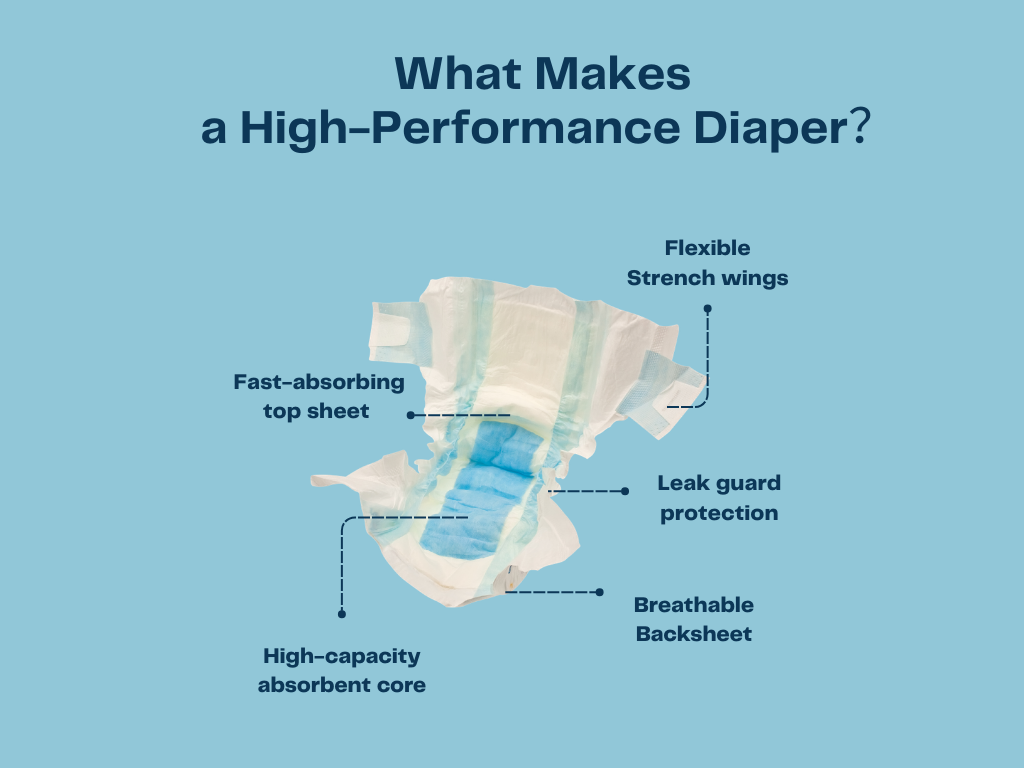
Modern disposable diapers typically consist of multiple functional layers, including:
Top Sheet
The layer directly contacting the skin, usually made of hydrophilic nonwoven fabric, responsible for rapidly directing liquid into the internal structure.
Acquisition Distribution Layer (ADL)
The liquid-guiding layer, designed to quickly diffuse urine and distribute it evenly.
Absorbent Core
The diaper's core structure, responsible for absorbing and storing liquids.
Backsheet
A breathable backsheet helps keep the diaper less stuffy.
Leak guard
Leg cuffs provide a better fit around your baby's body to prevent side leakage. This multi-layer structure forms the foundational design of modern diaper technology, ensuring liquids are swiftly directed into the absorbent core and locked away, thereby minimizing surface wetness.
For OEM clients, understanding these structures is a crucial step in evaluating diaper manufacturing technical capabilities.
Absorbent Core Innovation in Modern Diaper Technology
Among all diaper technology components, the absorbent core is the key determinant of absorbency performance.
The current mainstream absorbent cores typically consist of two materials:
SAP: The Core of Modern Diaper Absorption Technology
SAP is the core material in modern diaper technology, capable of absorbing and locking in liquids far exceeding its own weight. When urine enters the diaper, SAP rapidly absorbs moisture and forms a gel structure, trapping liquid internally to prevent leakage.
This technology enables diapers to achieve:
• High absorption capacity
• Slim design
• Long-lasting dryness
Without SAP, diapers would rely on large amounts of fluff pulp for absorption, resulting in bulky and uncomfortable products.
Core Structure Optimization
In advanced diaper manufacturing processes, manufacturers typically optimize the following parameters:
• SAP-to-fluff pulp ratio
• Absorbent core structure (traditional core vs. composite core)
Core width and compartmentalization design
For instance, some premium baby pull-up pants employ extended core designs to increase the absorption area, meeting the higher urine volume demands of toddlers.
For brands developing private label diapers, the absorbent core design often serves as a key differentiator for product positioning (e.g., daytime use, nighttime use, premium options).
Advanced Diaper Manufacturing Technologies
As market competition intensifies, modern diaper manufacturing has evolved into a highly automated and precision-engineered industrial system.
Advanced production lines typically feature the following technological capabilities:
1. High-Speed Production Lines
Leading international equipment achieves production speeds of:
600–1000 diapers per minute
High-speed production not only boosts output capacity but also ensures consistent product structure—a critical prerequisite for achieving high-quality diaper technology.
2. Composite Core Technology
In recent years, an increasing number of premium diapers utilize composite core technology, offering distinct advantages over traditional fluff pulp cores:
Thinner
More uniform absorption
Less prone to clumping
This technology is particularly prevalent in high-end baby pull-up pants and ultra-thin diapers.
3. Precision SAP Distribution
Advanced diaper manufacturing equipment enables precise control over SAP placement, such as:
Enhanced absorption in the front zone
Rapid fluid channeling in the middle zone
Reinforced liquid retention in the rear zone
This refined design represents a key development direction in modern diaper technology.
Diaper Technology Trends in the Global Market
As the global maternal and infant market continues to evolve, diaper technology is also advancing. Current international market trends primarily include:
1. Thinner but More Absorbent Diapers
Consumers desire products that are lighter and thinner while maintaining high absorbency.
Therefore, advanced diaper technology is achieving this through:
• Higher-efficiency superabsorbent polymers (SAP)
• Optimized core structure
• Improved wicking layer design
2. Skin-Friendly Materials
An increasing number of brands emphasize the following in private label diapers:
Soft non-woven fabrics
Breathable outer layers
Low-allergenic materials
These designs reduce skin irritation and enhance comfort.
3. Training Pants Market Growth
The global baby pull-up pants market is growing rapidly, primarily due to:
Increased activity levels during the toddler stage;
Parents' preference for pant-style diapers;
Easier to put on and take off;
Consequently, many diaper manufacturers are expanding production capacity for pant-style products.
4. Sustainable Diaper Technology
Environmental sustainability is a key trend in current diaper technology, exemplified by:
Biodegradable materials;
Bio-based raw materials;
Reduced plastic usage;
For instance, the U.S. Environmental Protection Agency (EPA) has highlighted the environmental impact of disposable diapers, prompting more brands to focus on sustainable material innovation.
Choosing the Right Diaper Manufacturing Partner
For companies seeking to build their own brand, selecting the right diaper manufacturing partner is crucial to ensuring product quality and market competitiveness.
A reliable manufacturer typically possesses the following capabilities:
A mature diaper technology R&D team
Multiple automated production lines;
Stable raw material supply chain;
Extensive experience in private label diapers;
For instance, some manufacturers offer complete product solutions ranging from baby diapers to baby pull-up pants, supporting customization of absorbent core structures, packaging designs, and brand positioning.
For more information on OEM diaper solutions, please visit our products category.
Conclusion
As the global maternal and infant market continues to evolve, diaper technology has become the core competitive factor in the disposable diaper industry. From SAP absorbent materials to composite core designs and advanced diaper manufacturing processes, each technological innovation continuously enhances the absorbency and comfort of disposable diapers.
For brand owners, understanding the key principles of diaper technology not only aids in selecting suitable suppliers but also facilitates the development of more competitive private label diaper products.
Looking ahead, advancements in materials science and manufacturing techniques will drive diaper products toward a future characterized by thinner, more absorbent, and more eco-friendly designs.
FAQ: Diaper Technology and Absorbency
1. What diaper technology makes a diaper highly absorbent?
A:Modern diaper technology primarily enhances absorbency through multi-layered structural design. High-absorbency diapers typically feature a hydrophilic non-woven top layer, an absorption distribution layer (ADL), and an absorbent core containing SAP (Super Absorbent Polymer).
SAP can absorb liquids far exceeding its own weight and lock moisture within its gel structure, thereby reducing leakage and maintaining a dry surface.
Additionally, advanced diaper manufacturing techniques optimize the absorbent core structure and SAP distribution to enhance overall absorption efficiency.
2. What is the most important material used in diaper technology?
A:In modern diaper technology, the most critical material is Super Absorbent Polymer (SAP).
SAP is a polymeric absorbent material that can absorb dozens of times its own weight in liquid and form a gel to lock in urine.
Without SAP, diapers would require large amounts of fluff pulp for absorption, resulting in thicker products and reduced absorption efficiency.
Therefore, the quality and usage ratio of SAP are typically key indicators for evaluating diaper manufacturing technology.
3. Are baby pull-up pants as absorbent as regular diapers?
A:High-quality baby pull-up pants typically offer comparable absorbency to standard disposable diapers.
Supported by advanced diaper technology, pant-style diapers often incorporate:
- Widened absorbent cores
- Enhanced front-zone absorption design
- Elastic waistband structures
These designs maintain stable absorbency even during periods of high infant activity.
Therefore, within modern diaper manufacturing systems, many baby pull-up pants now match the absorbency of traditional diapers.
4. How do private label diapers ensure product quality?
A:For brand owners, the quality of private label diapers generally depends on the OEM manufacturer's diaper technology and production standards.
Reliable manufacturers typically possess:
• Automated diaper manufacturing production lines
• Strict quality inspection procedures
• Stable raw material supply chains
• Absorption performance testing systems
When developing private label diapers, brands typically evaluate absorption speed, backflow rates, and leak resistance through sample testing to ensure products meet target market standards.
5. How to choose a reliable diaper manufacturing partner?
A:When selecting a diaper manufacturing partner, brands usually prioritize evaluating the following aspects:
• The manufacturer's diaper technology R&D capabilities
• Production equipment and automation level
• Product testing and quality control systems
• Experience in OEM production for private label diapers
Additionally, a manufacturer's ability to provide comprehensive solutions for diverse product types—such as baby diapers and baby pull-up pants—is a critical factor for establishing long-term partnerships in global markets.


