Most parents wonder when do baby teeth come in. The answer is usually around 6 months. Your baby's first tooth may arrive as early as 3 months or as late as 12 months. All of these ages are normal.
Every child follows a personal schedule. Some baby teeth come in early, and some come later. You do not need to compare your child to a neighbor's baby. Your baby teeth timeline belongs to your child alone.
Teething brings new questions, and the Baby Teeth Chart: Timeline for Eruption & Care Tips below gives you clear answers. Keep reading to see what to expect.
Key Takeaways
Each child’s teething schedule is different, and first teeth usually show up between 6 and 12 months.
Baby teeth usually come in a set order, starting with the bottom front teeth.
Ease teething pain safely with gum massage and chilled teethers, and stay away from risky products.
Plan your baby's first dental visit by age one or within six months of the first tooth.
Keep a simple log of each new tooth to share with your dentist and spot any delays early.
Baby Teething Chart: Timeline for Eruption & Care Tips
Reading the Baby Teeth Chart
A baby teething chart works best as a reference point, not a rulebook. Your child's 20 primary teeth usually begin arriving around 6 months. The full set of 20 baby teeth typically finishes by about age 2 to 3.
Read every age on a teething chart as a midpoint. The average first tooth appears around 6 months, yet the normal range stretches from 4 to 10 months. That gap matters. A tooth at 4 months and a tooth at 10 months both sit inside the normal window.
Keep a simple dental journal as you use this baby teeth chart: timeline for eruption & care tips. Write down the date each tooth appears. Note any symptoms you observe. Bring the log to dental visits. Your dentist can then interpret the pattern and make informed recommendations.
This timeline is a guideline — every child is unique, and eruption may be slightly earlier or later. Your pediatric dentist can help interpret any variations.
Eruption and Shedding Ages
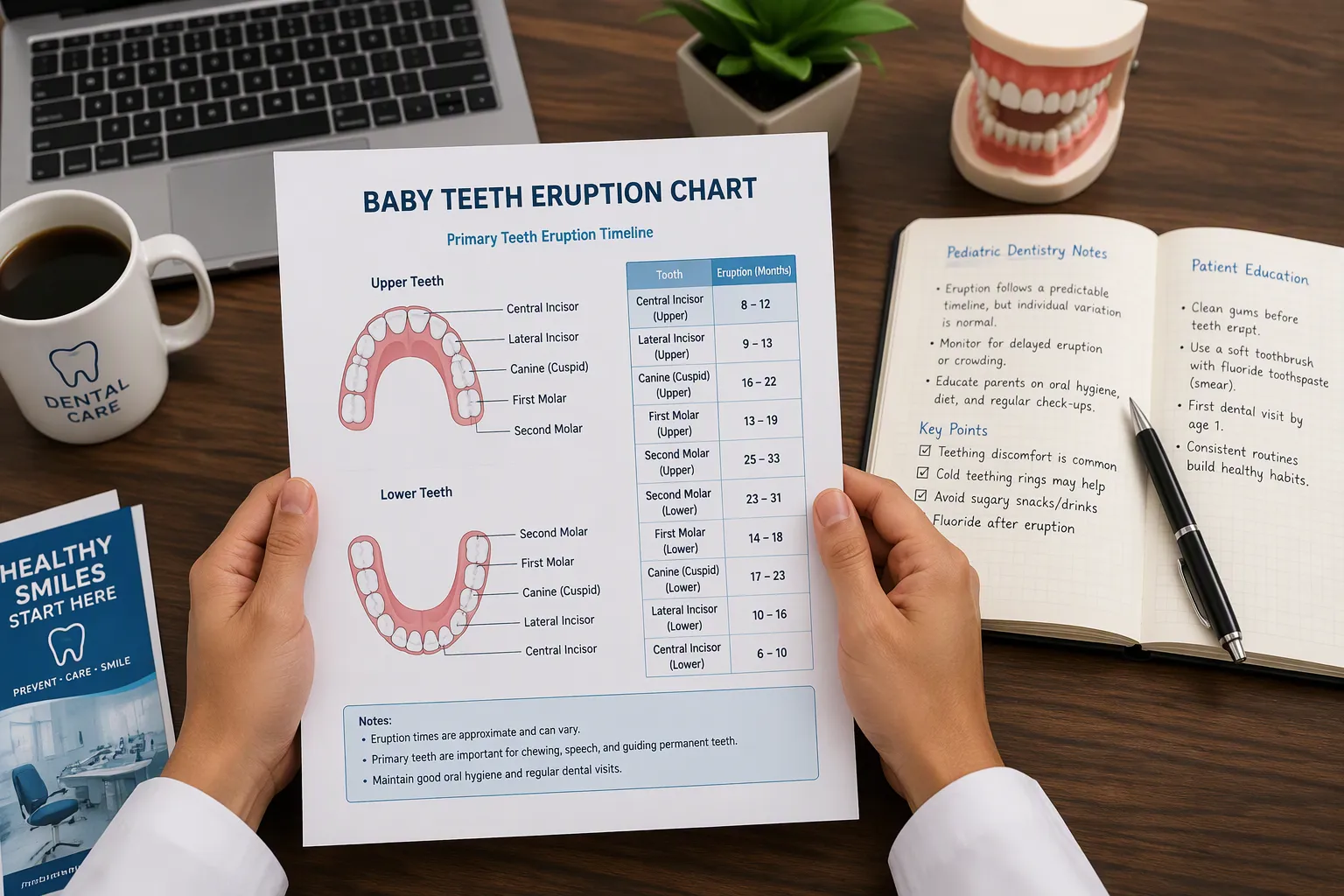
The table below shows typical ages for tooth eruption and shedding. The ranges come from American Dental Association eruption charts.
Tooth (Upper)
Erupts
Sheds
Central incisor
8–12 months
6–7 years
Lateral incisor
9–13 months
7–8 years
Canine (cuspid)
16–22 months
10–12 years
First molar
13–19 months
9–11 years
Second molar
25–33 months
10–12 years
Tooth (Lower)
Erupts
Sheds
---
---
---
Central incisor
6–10 months
6–7 years
Lateral incisor
10–16 months
7–8 years
Canine (cuspid)
17–23 months
9–12 years
First molar
14–18 months
9–11 years
Second molar
23–31 months
10–12 years
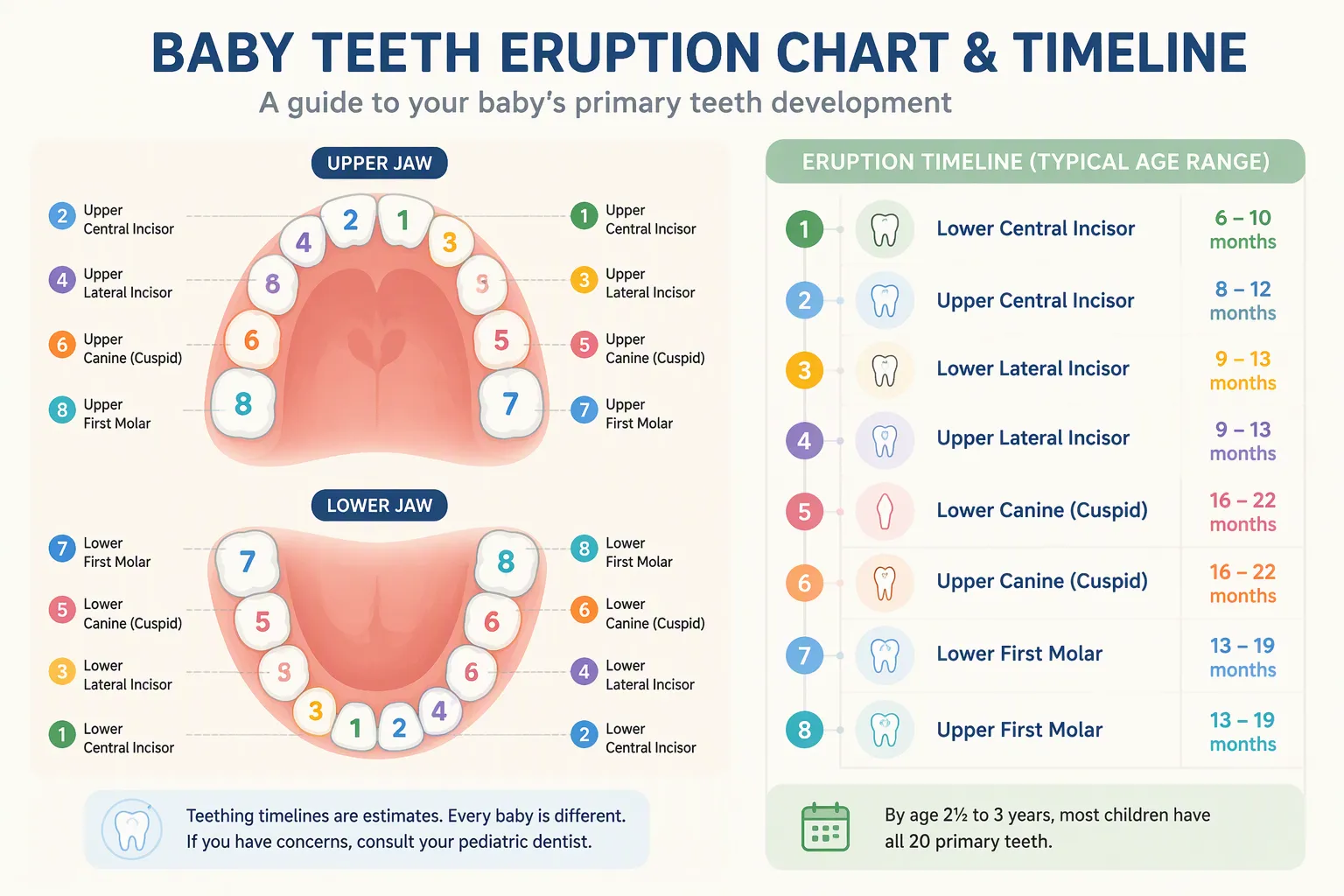
This teething chart covers the eruption of primary teeth in a clear order. The lower central incisors often arrive first. The upper lateral incisors and lower lateral incisors follow. Next come the lower first molars and upper first molars. Canines and second molars complete the set.
Use this baby teeth chart: timeline for eruption & care tips to spot patterns, not problems. A few months of variation is normal. Early or late eruption on its own rarely signals a concern. Family history, diet, and birth circumstances all influence timing.
Many parents ask whether a late tooth means trouble. No tooth by 12 months can still be normal. A dental check-up is a good idea at that point. If no teeth appear by 14 months, schedule a visit to rule out concerns.
Printable eruption charts and tracking apps can help you mark each milestone. A teething chart in your journal gives your dentist a clear picture at every visit. Keep this baby teeth chart: timeline for eruption & care tips handy, and update it as each tooth arrives. A teething chart is a tool for observation. Your child's own timeline will unfold at its own pace.
Baby Teeth Eruption Order & Timeline
Which Teeth Come First
You can usually predict which baby teeth come in first. The two middle teeth on the bottom, called the lower central incisors, are typically the first teeth to erupt. Chestnut Dental notes that these front teeth in the lower jaw usually appear between six and ten months of age.
The upper central incisors follow at eight to twelve months. Next come the upper lateral incisors at nine to thirteen months, then the lower lateral incisors at ten to sixteen months. This front-to-back pattern holds for most children, and it gives you a reliable way to follow the baby teeth eruption order.
One exception surprises many parents. The upper first molars and lower first molars usually arrive before the canines. So the baby teeth eruption order is not strictly front to back. The first molars erupt at thirteen to nineteen months, while the canines wait until sixteen to twenty-three months.
Typical Baby Teeth Eruption Timeline
The full baby teeth eruption timeline unfolds in a steady sequence. Here is the typical order baby teeth come in:
Lower central incisors — 6–10 months
Upper central incisors — 8–12 months
Upper lateral incisors — 9–13 months
Lower lateral incisors — 10–16 months
Upper first molars — 13–19 months
Lower first molars — 14–18 months
Upper canines — 16–22 months
Lower canines — 17–23 months
Lower second molars — 23–31 months
Upper second molars — 25–33 months
This baby teeth eruption order & timeline finishes with all 20 primary teeth by about age three. Between twelve and thirty-six months, your toddler gains the remaining baby teeth. Some children complete the set by age two, and others finish closer to age three. Both ends of that range are normal.
Parents often ask which baby teeth come in first when a tooth appears early or late. The first tooth can show up anywhere from three to twelve months. By seven months, many children have their first teeth, yet timing varies widely. An out-of-order eruption is often normal too. Your child may skip ahead to a molar or delay a canine without any problem.
Track the baby teeth eruption order & timeline in a simple log. Note each tooth and its arrival date. This record helps your dentist see the pattern at checkups. Trust the sequence as a guide, and let your child's own timeline unfold.
Teething Symptoms and Soothing Tips
Common Teething Signs
You will probably see a few teething signs as your baby's first teeth come through. Extra drooling is often the first one. Your baby may also chew on anything nearby, since pressing on sore gums feels good. Mild fussiness and trouble sleeping are common too, because lying down makes the discomfort feel worse.
A mild low-grade temperature under 100.4°F can come with teething. But a fever of 100.4°F or higher points to illness, not teething. Pulling at the ears again and again with a high fever points to an ear infection. Diarrhea, vomiting, or a rash near the gums are not caused by teething and warrant a call to your pediatrician.
Contrary to popular belief, teething does not cause diarrhea, fever, or diaper rash. Because infants lose maternal antibodies around six months, they become more susceptible to colds—so persistent crankiness or discomfort lasting several days should be evaluated by a pediatrician to rule out other conditions.
Feature
Teething
Infection
Fever
Mild, under 100.4°F
High, above 100.4°F
Gums
Red, swollen, tender
Not affected
Nasal/respiratory
None
Congestion, runny nose, cough
Duration
3–8 days per tooth
Longer, persists without treatment
Safe Soothing With Chiaus Baby Care
You can ease teething discomfort with simple, safe methods. Rub sore gums with a clean finger. Give a chilled—not frozen—washcloth or a solid-rubber teether to chew on. Avoid numbing gels with benzocaine, teething necklaces, and homeopathic tablets, which carry serious risks.
Keep your baby's face and hands clean during heavy drooling. Chiaus baby wet wipes offer a practical way to wipe drool and sticky fingers throughout the day. For everyday changes, Chiaus baby diapers or bamboo eco-friendly diapers help keep your little one comfortable during this fussy phase.
Track each tooth's arrival in your log to build a clear timeline for your child. Most teething episodes last 3–8 days per tooth. If symptoms stretch beyond that window, check with your pediatrician.
When to See a Dentist
Some symptoms mean there is a problem beyond normal teething. Call your pediatrician if your child has a high fever of 100.4°F or higher, keeps vomiting, has serious diarrhea, or shows signs of dehydration. Get dental help right away for big swelling inside the mouth, facial swelling, pus, or severe mouth pain.
Delays or Missing Teeth
Make a dental visit if your child has no teeth by 18 months. A missing tooth or a tooth with an odd shape also needs a check. So does any worry about the order teeth come in. Your dentist can look at the gums and take images if needed.
Delayed eruption has many causes. Local factors include retained primary teeth, early loss of primary teeth, and insufficient arch space. Supernumerary teeth can delay or block central incisors in 26–50% of cases. Genetics, premature birth, and nutritional deficiencies also play a role. Most of these causes can be handled once they are found.
Early Dental Care Basics
Book the first dental visit by age one or within six months of the baby's first tooth. The first visit usually lasts 30 to 45 minutes. Your dentist will check oral development, talk about feeding and fluoride exposure, and coach you on brushing. Follow-up visits usually happen every six months.
The first dental visit should occur no later than 12 months of age.
Start brushing with the very first tooth. Use a soft brush and a tiny smear of fluoride toothpaste, about the size of a grain of rice. The American Academy of Pediatrics recommends fluoridated toothpaste for all children starting at tooth eruption. Brush twice daily and supervise your child.
Write down each new tooth in your log. This simple timeline helps your dentist spot delays early. Ask about fluoride varnish at checkups, since the AAP recommends it every 3–6 months from tooth emergence. Early visits help your child feel at ease and catch small problems before they grow.
Treat this chart as a guide, not a strict rule. Most children have all 20 baby teeth by age three, and a wide normal range surrounds every age you see. Your child's own pace matters more than any single date.
Keep three action steps in mind. Soothe teething discomfort safely with gum massage and chilled teethers. Start brushing with a soft-bristled baby toothbrush as soon as the first tooth appears. Schedule a first dental visit by age one or within six months of that first tooth.
Trust your instincts. You know your child best. If a concern lingers, contact a pediatric dentist. You are doing a great job.
FAQ
When does the first baby tooth usually appear?
Most first teeth arrive around 6 months. The normal window stretches from 3 to 12 months. Your child's own schedule may sit anywhere in that range. Watch for drooling and gum rubbing as early hints.
Is it a problem if my baby's teeth arrive late?
Usually not. Many children with no teeth at 12 months still develop normally. Book a dental visit if no teeth appear by 18 months. Your dentist can check the gums and rule out concerns.
Does teething cause a high fever?
No. Teething may bring a mild low-grade temperature under 100.4°F. A fever of 100.4°F or higher points to illness. Call your pediatrician for a high fever, vomiting, diarrhea, or a rash.
How long does each teething episode last?
Most episodes run 3 to 8 days per tooth. Symptoms beyond that window deserve a call to your pediatrician. Track each new tooth in a simple log so you can spot patterns.
When should I schedule the first dental visit?
Book the first visit by age one or within six months of the first tooth. Your dentist will check oral development and coach you on brushing. Expect follow-up visits every six months.