The global infant and toddler diaper market is undergoing profound transformation, with the market size projected to exceed $80 billion by 2025. The Asia-Pacific region contributes over 60% of this market share, while penetration rates in North America and Western Europe surpass 98%. In contrast, emerging markets such as Southeast Asia and Africa exhibit penetration rates below 40%, harboring significant growth potential. For overseas buyers, selecting premium diaper manufacturers and suppliers while gaining in-depth knowledge of diaper manufacturing processes and standards is crucial to seizing market opportunities. The expertise in diaper manufacturing directly determines product quality, compliance, and market competitiveness. This article comprehensively analyzes the core aspects of diaper manufacturing, international compliance requirements, and evaluation criteria for quality suppliers, based on global market demands, providing authoritative reference for B2B clients worldwide.

Core Processes in Diaper Manufacturing
Diaper manufacturing is a systematic engineering process integrating materials science, precision manufacturing, and quality control. The creation of premium products involves four core stages: raw material selection, core component manufacturing, integrated molding, and rigorous testing. Leading global diaper manufacturers establish standardized processes at each stage to meet international market demands, ensuring consistent product quality and suitability for diverse regional usage scenarios.
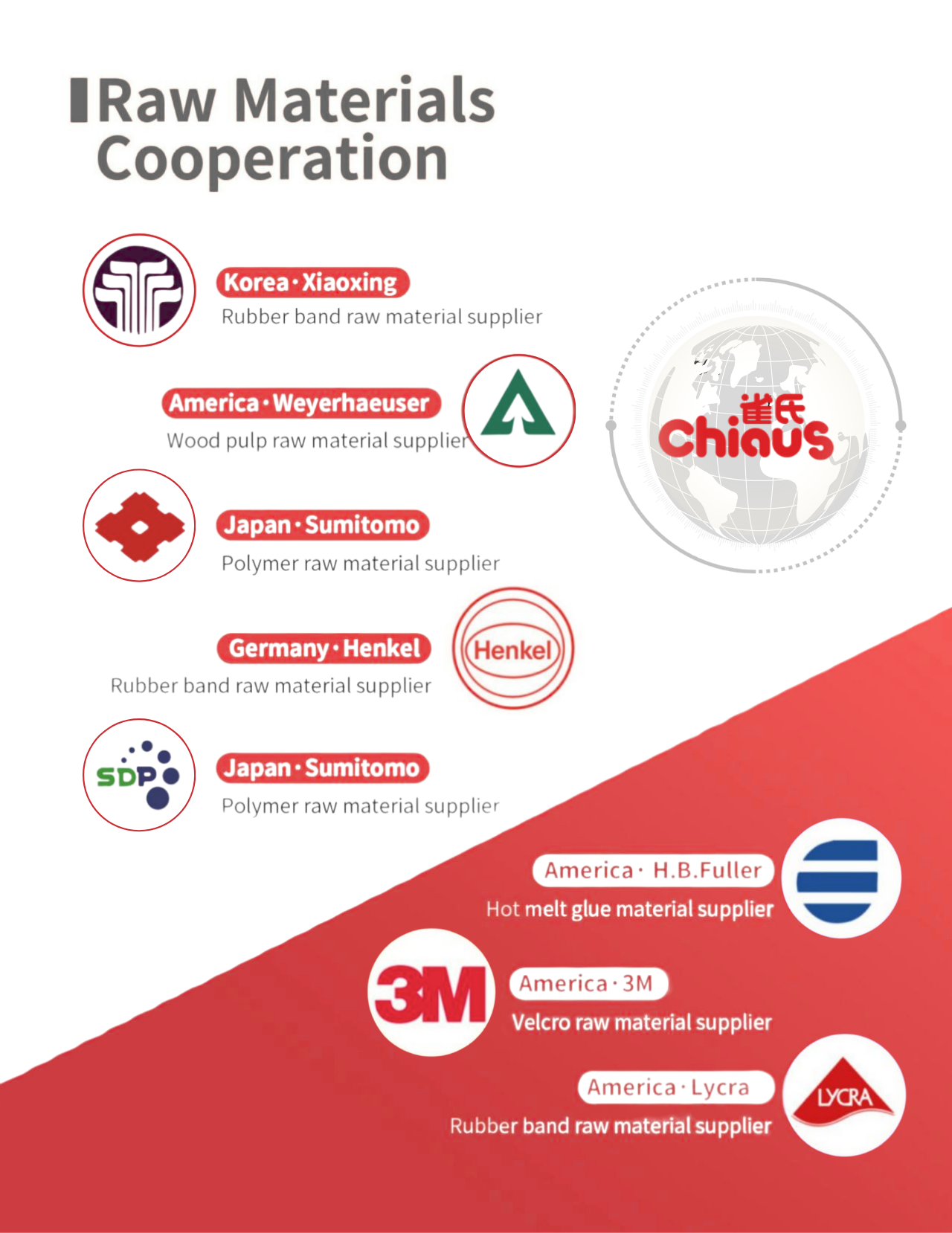
International markets impose increasingly stringent requirements on raw materials, particularly as chemical substance control standards in Europe and the Americas continue to evolve. Premium diaper manufacturers typically source materials from world-leading suppliers, such as Sumitomo Chemical's superabsorbent polymer (SAP) from Japan, Henkel's eco-friendly wetness indicator materials from Germany, and H.B. Hotmelt adhesives from the United States. During the material selection process, multiple tests are conducted to verify raw material safety, with a focus on screening for harmful substances like lead and phthalates to ensure compliance with all international regulations. Chiaus has established a global procurement and testing system for raw materials in diaper manufacturing. All materials undergo REACH-certified chemical control testing. The operational procedures of the raw material testing laboratory can be viewed in the VR factory section at chiausdiapers.com.
Core component manufacturing is the technological heart of diaper production, primarily encompassing the fabrication of absorbent cores, breathable topsheets, and leak-proof side barriers—each stage involving critical precision engineering techniques.
As the "heart" of the diaper, the absorbent core's manufacturing process directly impacts absorbency and leakage rate. The current international standard for composite core production employs a "three-layer composite hot-air process":
Step one involves forming the bottom layer with hot-air nonwoven fabric. At 280°C, hot air melts PP fibers, which are then laid into a web and thermally rolled to form a base layer weighing 25-30g/㎡.
Step two involves precise dispersion of super absorbent polymer (SAP) particles. A servo-motor-controlled quantitative powder-dispersion system evenly distributes SAP particles (150-300μm in diameter) onto the base layer according to product specifications (newborn/training pants), with a controlled dispersion rate of 180-350g/㎡. Simultaneously, 2-3% wood pulp fibers are added to enhance the core's structural integrity.
Step 3 involves covering the top layer with hot-air nonwoven fabric and ultrasonic bonding. Utilizing 20-30kHz ultrasonic welding technology, diamond-shaped bonding points spaced 5-8mm apart are formed on the core surface. Welding pressure is controlled at 0.3-0.5MPa to ensure robust interlayer adhesion without compromising SAP absorbency. Driven by European market demand, biodegradable bio-based core materials are increasingly adopted. These cores utilize PLA (polylactic acid) nonwoven fabric and PBAT (polybutylene adipate terephthalate)-modified SAP. Production requires an additional material pretreatment step—low-temperature drying at 60°C to remove moisture from bio-based materials, preventing stability issues during forming. This addresses requirements under the EU Single-Use Plastics Ban. Manufacturing breathable outer layers prioritizes skin-friendliness and air permeability. The mainstream "hot-air perforation web-forming process" stretches PP/PE composite fibers with 300°C hot air, then forms a nonwoven fabric weighing 18-22g/m² through air-laid web formation. A napping machine then applies a micro-napping treatment to the surface, achieving a surface roughness Ra ≤ 5μm for enhanced skin-friendly tactility. High-end products employ a "cotton fiber blend process," mixing 30% natural cotton fibers with 70% PP fibers. This blend is formed via hydroentanglement to enhance breathability and moisture absorption. The production of leak-proof side panels requires balancing elasticity and durability, utilizing a "spandex yarn pre-stretch composite process": First, 20D/30D spandex yarn undergoes 1.8-2.2 times pre-stretching. It is then laminated with two layers of 15g/㎡ spunbond nonwoven fabric using hot melt adhesive at 120-140°C. Finally, the laminate is cut into 8-12mm wide barrier strips, ensuring a stretch recovery rate ≥95% for a snug fit that conforms to the infant's body shape without deformation.
Leading global diaper manufacturers universally adopt fully automated production lines. Core equipment includes Germany's Krones fully automated core forming machines, Japan's Nachi waist tape assembly systems, and Italy's Comexi high-speed packaging machines. This enables fully unmanned operation from raw material input to finished product packaging, achieving production rates of 800-1200 pieces per minute. The specific integrated molding process and technical points are as follows:
Core Forming Process: Utilizes vacuum-adhesion core forming machines. Negative pressure precisely positions composite core materials with ±1mm tolerance. An online weighing system continuously monitors core weight, automatically halting production for adjustment when deviations exceed ±5g.
Surface Layer Laminating Process: Electrostatic lamination technology creates an electrostatic bond between the breathable surface layer and the core surface. This is combined with roller compression at 0.2MPa pressure to avoid excessive hot melt adhesive usage that could compromise breathability.
Leak-proof Side Seals and Waist Tape Assembly Process: A vision positioning system precisely attaches preformed leak-proof side seals to both sides of the surface layer with positioning accuracy of ±0.5mm. Waist tape assembly employs robotic hot-melt welding technology at 130-150°C for 0.3 seconds, ensuring bond strength ≥2.5N/25mm;
Elastic waistband lamination process: Utilizes a pre-stretch lamination technique, stretching the elastic waistband material 1.5 times before bonding it to the diaper body. The laminated material is rapidly set via a cooling device (temperature 10-15°C) to prevent elastic recoil;
Cutting and Forming Process: Employ circular blade rotary cutting technology synchronized with production line cadence. Achieve cutting precision of ±0.3mm while integrating a waste material recovery system for real-time recycling of cutting scraps.
Finished Product Packaging Process: High-speed film packaging machines enable individual or multi-piece bundled packaging. Film heat-sealing occurs at 180-200°C for 0.5 seconds, with online printing of production batch numbers and expiration dates. Metal detectors (sensitivity: Fe≥0.8mm, SUS≥1.2mm) screen for metallic contaminants. For instance, Chiaus diaper manufacturing workshop operates as a static Class 100,000 cleanroom. It integrates the aforementioned fully automated production line with real-time 4K camera monitoring.
Additionally, an AI vision inspection system performs 100% checks on core material distribution uniformity, waist tape positioning, and product appearance defects. Inspection efficiency reaches 1,200 pieces per minute, with over 550 quality control checkpoints ensuring consistent specifications for every product and reducing defect rates below 0.8%. Against the backdrop of rising global demand for flexible production, advanced diaper manufacturing lines can rapidly switch product parameters via PLC control systems. This enables swift transitions between multiple specifications (newborn, M/L/XL sizes, training pants) within ≤30 minutes, reducing small-batch customized order processing cycles to 7 days. This meets the differentiated needs of customers across various regions.
Testing encompasses three major categories: physical properties, chemical safety, and hygiene indicators. Physical properties include absorbency, reverse leakage, breathability, and tensile strength. Chemical safety focuses on harmful substances such as heavy metals, phthalates, and formaldehyde. Hygiene indicators monitor microbial metrics like total bacterial count and total fungal count. To meet compliance requirements across different markets, diaper manufacturers must complete corresponding testing and certification . Chiaus has established an internationally accredited laboratory for its diaper manufacturing testing phase, capable of performing compliance testing for major global markets. This ensures products smoothly pass customs inspections in various countries. Details regarding testing capabilities can be found in the Customized Services section of our official website.
Core Evaluation Criteria for Selecting Diaper Suppliers in the International Market
For overseas B2B clients, selecting a reliable diaper supplier is crucial for business success, with diaper manufacturing capabilities serving as the core evaluation dimension. In the fiercely competitive international market, a premium diaper manufacturer should possess a comprehensive production system, stringent quality control, flexible customization capabilities, and full compliance safeguards. From a diaper manufacturing perspective, the following outlines five core evaluation dimensions for selecting diaper suppliers, aiding overseas clients in making precise decisions.
First, assess the technical capabilities and production capacity scale of diaper manufacturing. Technical strength manifests in the sophistication of production equipment, maturity of core processes, and R&D innovation capacity. A premium diaper manufacturer should feature fully automated production lines with an automation rate of no less than 85%, coupled with flexible production capabilities to swiftly respond to small-batch custom orders. Production capacity must align with client procurement needs while maintaining continuous expansion capabilities to ensure supply chain stability. As a seasoned diaper manufacturer, Chiaus operates multiple modern production bases with annual manufacturing capacity reaching billions of units. Through chiaus'sVR factory tour, clients can visually inspect production scale and equipment configuration. Its OEM service covers the entire process from sample development to mass production, catering to clients of all sizes.
Second, evaluate the diaper manufacturer's quality control system. Comprehensive quality management must span raw material procurement, production processes, and finished product testing. The manufacturer should maintain an independent laboratory equipped with specialized testing equipment to ensure products comply with target market regulations. Customers may request suppliers to provide relevant test reports and certification documents, such as the U.S. CPC certificate or EU REACH compliance reports. On-site inspections of production workshops and testing laboratories may be conducted when necessary. Chiaus has established over 550 quality control checkpoints throughout its diaper manufacturing process, enabling full-process visual monitoring. All products undergo testing across three major categories: physical properties, chemical safety, and hygiene indicators. Relevant test reports can be verified and queried via the official website.
Third, evaluate material sourcing and cost control capabilities in diaper manufacturing. Materials are pivotal to product quality and cost. A premium diaper supplier should maintain stable global procurement channels for raw materials, source from top-tier suppliers, and control costs through bulk purchasing and process optimization. Amid growing environmental awareness, manufacturers must also demonstrate expertise in applying green materials like bio-based substances and biodegradable packaging to meet international sustainability demands. Chiaus employs a global centralized procurement model in diaper manufacturing, establishing long-term partnerships with top material suppliers like BASF and Hanwa. Through integrated production processes, we reduce costs to provide customers with high-value product solutions.
Fourth, evaluate compliance assurance capabilities in diaper manufacturing. Compliance is a prerequisite for entering international markets. Diapers suppliers must be familiar with regulations across different markets and maintain robust compliance management systems to ensure the entire manufacturing process meets target market standards. Customers should prioritize evaluating suppliers' compliance certifications, labeling management capabilities, and responsiveness to regulatory updates. Chiaus has established a global compliance database for diaper manufacturing, tracking real-time regulatory changes worldwide. It offers compliance consulting and certification assistance services, with products certified by SGS, FDA, EU CE, and other international standards, enabling seamless entry into major global markets.
Conclusion
As a seasoned enterprise specializing in diaper manufacturing,Chiaus consistently aligns with international market demands, continuously refining production processes, enhancing compliance safeguards, and perfecting service systems. We look forward to establishing long-term, stable partnerships with global B2B clients. Leveraging two decades of professional manufacturing expertise, we aim to jointly seize development opportunities in the global diaper market. For further information or collaboration inquiries, please contact us via the details provided on our official website.


