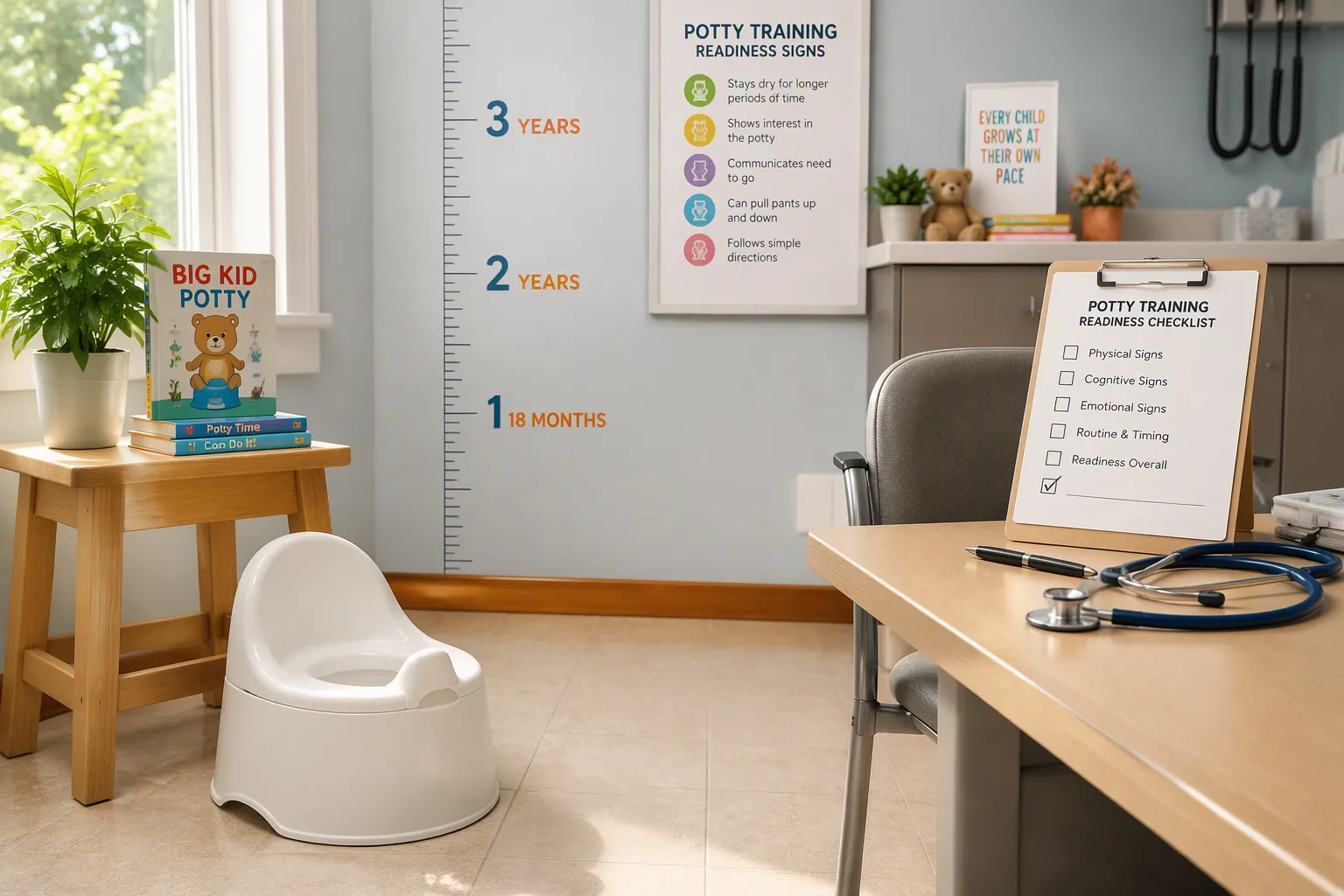
Most children are ready somewhere between 18 and 36 months. That is the honest answer to when to start potty training, and it covers a wide, healthy range. The American Academy of Pediatrics suggests introducing the potty around 18 months, then watching for clear readiness signs, which usually show up between 18 and 30 months. Some kids take to potty training near their second birthday. Others need more time, and that is normal too. You may worry about starting too early or too late. Try not to stress. A child-led approach works well, and most children master daytime dryness between ages 2 and 3.
Key Takeaways
Most children are ready for potty training between 18 and 36 months. However, the signs that a child is ready matter more than their age.
Watch for physical signs, like a dry diaper for two hours. Also look for motor skills, like pulling pants down.
Thinking and feeling signs include following simple directions and showing interest in the bathroom.
Get ready with a potty that fits your child, clothes that are easy to take off, and practice with no pressure to help them feel comfortable.
If your child fights it or doesn't seem interested, stop and try again later; being patient is key.
When to Start Potty Training: The Short Answer
Most children show signs of readiness between 18 and 36 months. That is the short answer to when to start potty training. Yet the calendar alone tells you very little. Readiness is more important than age, and that idea should guide your whole approach. The healthy range is wide. You can start potty training with confidence once the signs line up.
Why Readiness Beats a Birthday
Research shows that potty readiness does not come from a single birthday. Developmental readiness grows slowly from bladder control, nervous system maturation, body awareness, motor skills, communication, and emotional regulation. Two children the same age can differ in sensory processing, temperament, and body awareness. One toddler is ready for potty training at 20 months. Another needs until 3. Pushing too early can backfire with fear, withholding, and power struggles. Research supports a responsive, supportive approach instead of forceful training. Watch for readiness in skills and behavior, not in months. A child who follows a simple two-step instruction and pulls pants down has a real head start. Interest and cooperation are strong green lights. A child who shows both is usually ready to start potty training.
The Typical Window: 18 to 36 Months
Studies point to a favorable window of roughly 18 to 30 months. Many children show their strongest signs around 24 to 27 months. That does not mean every child should train by age 2. Think about age in combination with developmental readiness. Your child may be ready to begin the toilet training process a bit earlier or later. Watch for the right time to start potty training by looking at skills, not the date. Ask yourself when you should start potty training, then check whether your child is ready for potty training in daily life. A dry diaper after a nap and real interest in the bathroom tell you more than any chart. Some children train in a few weeks. Others take several months. Both paths are normal. Trust the second round of signs when they appear.
What Age to Start Potty Training
Parents often ask what age to start potty training, and the honest answer covers a broad span. Most children begin somewhere between 18 months and 3 years. Each child develops at their own pace, so no single month fits everyone. The question of when to start potty training comes up at the 18-month, 2-year, 2½-year, and 3-year well-child visits. Those checkups give you a natural chance to ask questions and compare notes with your pediatrician.
Early Starters (18 to 24 Months)
Some toddlers show clear signs before their second birthday. A child in this group communicates needs well, wakes from naps with a dry diaper, and walks to the bathroom. She may help remove clothing, show curiosity about the potty, or dislike wet diapers enough to request a change. She might also ask for underwear like an older sibling. Physical mobility matters here: steady walking and the ability to sit down and stand up alone. Sitting and standing independence matters as well. Your child should lower herself onto a potty or stool and rise again without help. Instruction comprehension matters too. A toddler who follows a short two-step direction, such as pulling pants down and sitting, has a real head start. This window often works well because toddlers tend to be curious and cooperative before the resistant "no!" phase. Research backs this up. Children who began between 18 and 24 months took 13 to 14 months to train, compared with 10 months or less for those who started after 27 months. Younger starters were no more likely to have accidents or refuse the stool, but training simply took longer. You can start potty training here with confidence if the signs line up.
The Sweet Spot and Later Starters (24 to 36+ Months)
So what is the best age to start potty training? Studies point to 27 to 32 months as the sweet spot for most children. The average age to start potty training in the US now sits at 33 months, up from 24 months in the 1970s. The most common starting window is 25 to 30 months, and few families begin before 18 months or after 42 months. Most children begin between 21 and 36 months, yet only 40 to 60 percent finish by 36 months. That gap tells you something useful. Many children are still learning well past their third birthday, and that is normal. Starting after 32 months may bring more accidents and more difficulty. The right age to potty train depends on signs, not the calendar. Watch for readiness in skills and behavior. Developmental readiness grows from bladder control, body awareness, and communication. The average potty training/readiness age falls between 2 and 3 years of age, so your child has plenty of room. Think of potty training age as a range, not a deadline. A later potty-training age is not a problem. Many children simply need more time to build bladder control and body awareness. Potty training works best when you follow your child's cues. Treat potty training as a partnership, not a schedule. Potty training takes patience and consistency.
Signs of Readiness for Potty Training: Physical
Physical readiness is the clearest proof that your child's body is catching up with the idea of using the potty. Look for these signs of readiness for potty training in everyday life. They appear in diapers, in posture, and in small acts of independence.
Dry Stretches and Diaper Awareness
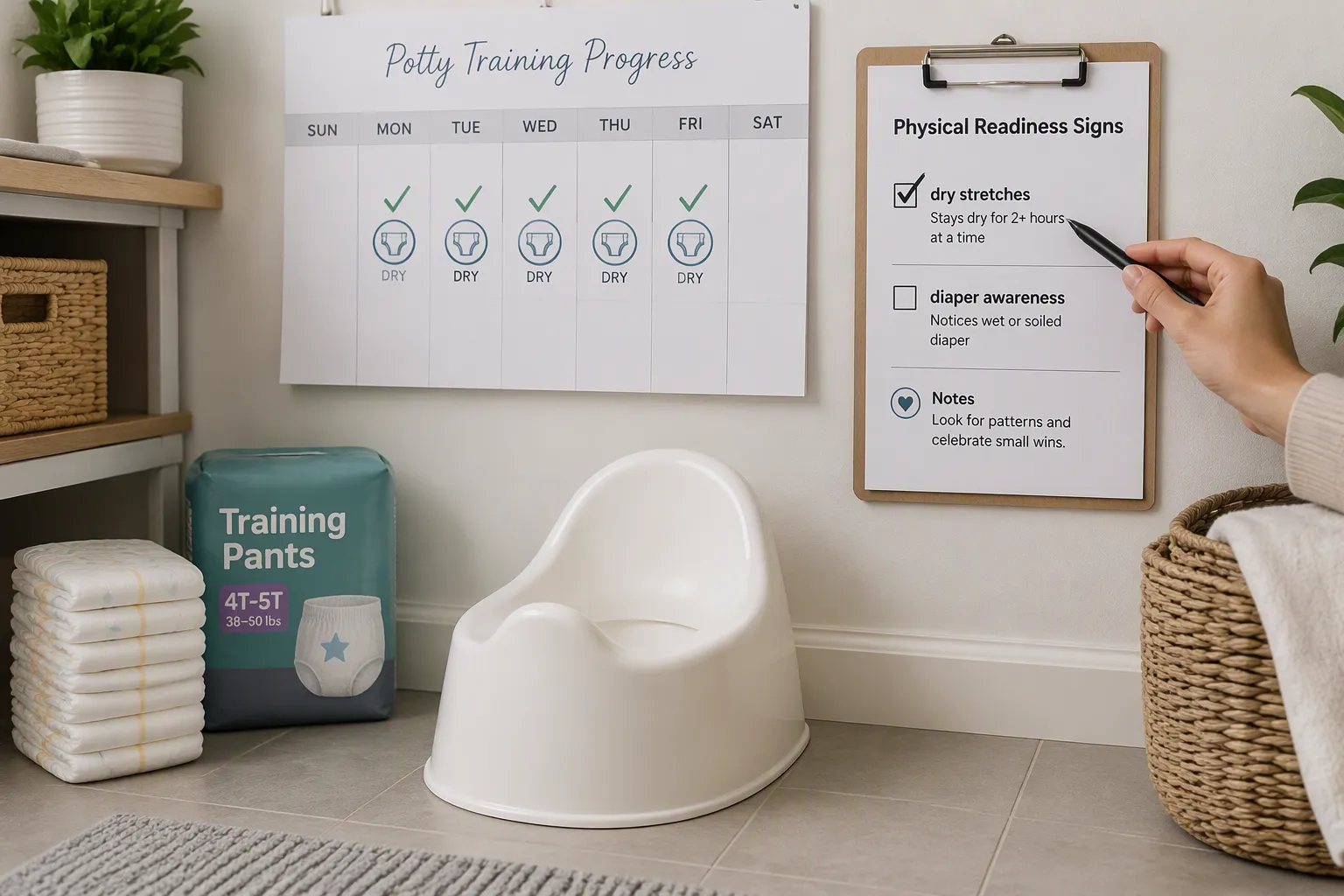
Dry stretches are one of the most reliable signs of potty training readiness. A child who stays dry for two hours or more during the day, or wakes up dry from naps, meets the exact rule the 3 Day Potty Training Method uses to judge daytime readiness. Use this table as your checklist:
Category
Physical Readiness Sign
What It Indicates
Dry stretches
Wakes from 1.5–2 hour naps with a dry or barely damp diaper
Bladder muscles getting stronger and the nervous system maturing
Dry stretches
Two or more hours between diaper changes while awake
Bladder capacity growing and control developing
Dry stretches
Diaper stays dry after certain outings (store, park)
Pauses, stands still, or focuses mid-activity while going
Child notices the feeling of going
Diaper awareness
Hides behind furniture or in a corner to poop
Understands what is happening and wants privacy
Diaper awareness
Says words like "I peeing" or "poopoo," or points to the diaper
Links body feelings with the result
Diaper awareness
Shows discomfort with a wet or dirty diaper and asks to be changed
Understands the cause and effect of going
These common signs of potty training readiness matter more than any single milestone. One dry nap is a good start. A pattern of dry stretches plus diaper awareness tells you real potty readiness is building.
Motor Skills and Independence
Motor development is a practical but often overlooked part of potty training readiness. Your child needs to sit safely on a potty, stand up without help, and walk to the bathroom. Check these signs of potty training readiness:
Steady movement: your child walks between rooms without tripping.
Sitting and standing: your child gets on and off a small chair or potty alone.
Clothing skills: your child pulls elastic-waist pants down and up, a key fine motor skill.
Climbing and squatting: your child climbs a step stool or squats during play.
Dressing alone: your child insists on putting on shoes or pants, even while struggling.
Joining routines: your child tries to brush teeth or wash hands without help.
Following directions: your child can follow simple two-step commands.
Wanting no help: your child pushes your hands away when set on finishing a task alone.
Pulling pants up and down, even imperfectly, supports independence. Washing hands with little help builds healthy habits. Children who feel proud of doing things "by myself" often learn to use the toilet quickly. Waiting until these motor skills are in place helps you avoid physical frustration that can turn into emotional resistance. For a fuller picture, pair these physical cues with the 7 readiness signs & expert tips covered across this guide, and treat each small win as progress.
Cognitive and Emotional Readiness Signs
Your child's body can be ready before their mind catches up. Cognitive and emotional signs of potty training readiness matter just as much as dry diapers. Watch for these cues in daily life:
Your child follows simple directions, like "get your shoes and bring them to me."
Your child tells you they need to go, using words, signs, or gestures.
Your child shows curiosity about the bathroom and follows you in.
Your child tugs at a wet diaper or asks for a change.
Your child wants to do things "by myself."
Your child hides in a corner to poop, showing awareness of privacy.
Understanding Instructions and Body Signals
Noticing a full bladder is its own skill. Experts call it interoception, sometimes described as the "eighth sense." It means your child can feel an internal signal and connect it to a need. Body awareness like this typically emerges around 12–18 months. Planning and problem-solving grow stronger by age two and beyond.
You can build this skill through play and talk. Ask, "Do you have that pee or poop feeling?" Your child learns to name the sensation, picture the potty, and make a plan to get there. This is the heart of potty training readiness. A child who understands your explanations can follow the whole routine, from noticing the feeling to asking for help.
Interest, Cooperation, and Independence
Interest and cooperation are strong green lights. A curious child who watches siblings and wants a turn is showing real signs of readiness for potty training. A child who avoids the bathroom or resists potty talk is telling you something too. That child needs more time.
Independence fuels motivation. Kids who insist on pulling pants up and down feel proud and capable. Give your child small jobs and some control over the process. Pressure backfires, though. Forcing the issue invites power struggles and setbacks. Stay calm, offer gentle reassurance, and keep the mood light. These emotional signs of readiness for potty training often predict success better than any calendar date. When interest, cooperation, and independence line up with physical cues, your child's potty readiness is likely solid. Trust that combination, and let developmental readiness set the pace.
Boys vs. Girls in Potty Training
Average Timing and What It Really Means
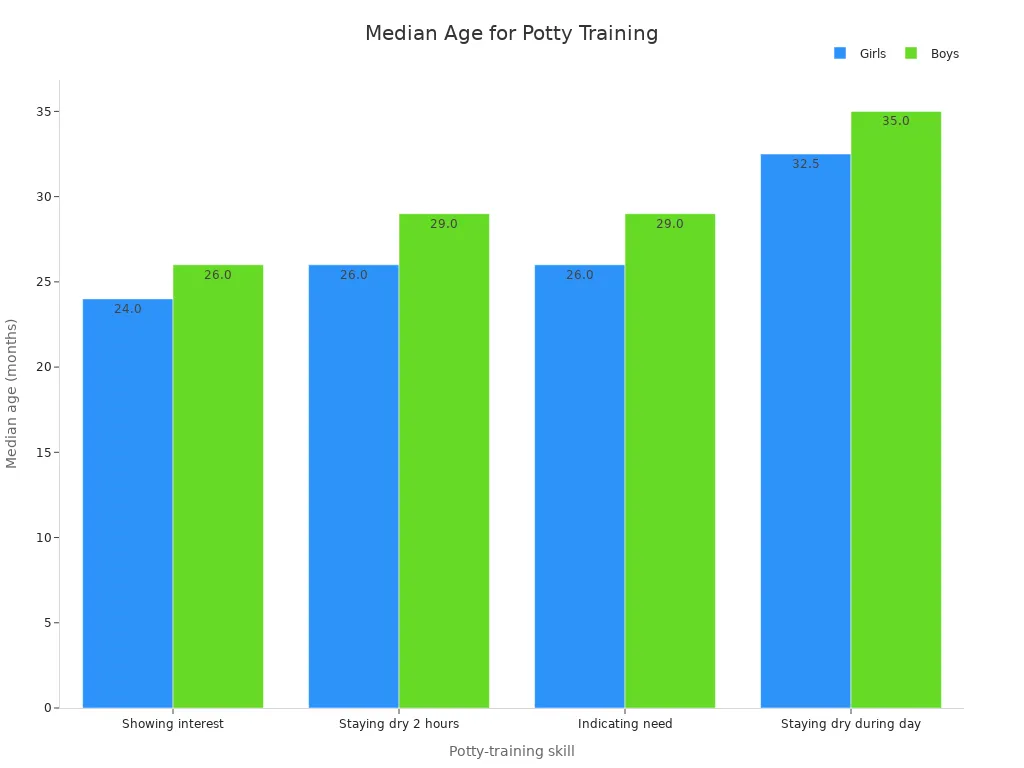
You may have heard that girls train earlier than boys. The data shows small differences, not a rule. Girls often reach key milestones a few months sooner. Check the medians below:
Potty-training skill
Girls (median age)
Boys (median age)
Difference
Showing interest in using the potty
24 months
26 months
2 months
Staying dry for 2 hours
26 months
29 months
3 months
Indicating a need to go to the bathroom
26 months
29 months
3 months
Staying dry during the day
32.5 months
35.0 months
2.5 months
Those gaps look tidy on paper. Real life is messier. Some boys show interest at 22 months. Some girls need until 3. Pediatric experts stress that timelines vary widely, and developmental readiness beats gender every time. Treat the chart as a rough guide, not a scoreboard.
Overall, the average age of full potty training does not differ between boys and girls, although an older study suggested girls may be more advanced in expressing the need to use the potty and in mastering bowel and bladder control.
So what does this mean for your family? Girls may start slightly earlier, and the process may go somewhat quicker for them. That does not make one path better. Your child's potty-training age depends on skills, temperament, and body awareness. Watch your own child for signs of readiness. A boy who pulls his pants down and asks for the potty is ready now. A girl who hides and resists needs more time. Skip the comparisons with cousins and playgroup friends. Focus on your child's cues, keep potty training low-pressure, and celebrate each small step.
How to Prepare to Start Potty Training
Setup, Language, and Low-Pressure Practice
Good preparation makes the first days smoother. Start by watching your child's current routine. Track wet diapers and bowel movements for a few days. You will learn when your child usually goes. Then pick a calm week with no travel, no move, and no new sibling. Consistency matters more than speed here.
Set up the space before you begin. Choose a child-sized potty or a toilet seat insert with a sturdy step stool. Let your child help pick it out. Stock easy-on clothing like elastic waistbands, loose dresses, or just underwear. Build a small potty station with wipes, toilet paper, hand soap, and a basket of books. Keep spare clothes and cleaning supplies nearby for accidents. A sticker chart or a potty book adds fun without pressure.
Language does a lot of work at this stage. Use simple, matter-of-fact words. Try show-and-tell: let your child watch you use the bathroom and narrate each step out loud. Say, "I feel like I have to go potty. I sit down and pee. Then I wipe, flush, and wash my hands." A one-page picture story about the toilet, underwear, and rewards helps too, since children understand pictures better than words alone. Let your child sit on the potty fully clothed while reading a book. This builds comfort before any real attempt.
Diapers and pull-up pants can ease the transition. Chiaus diapers work well for naps and overnight, and Chiaus pull-up pants let your child practice pulling clothes up and down during the day. Think of them as bridge tools, not a step backward. When you wonder how to start potty training, remember that readiness grows through calm exposure. Keep your tone neutral. Skip bribes, shaming, and scolding. Treat accidents as normal, and treat training days as bonding time. That mindset carries you through the messy moments.
When to Wait or Pause Potty Training
Sometimes the smartest move is to wait. A few clear signals tell you to hold off. Your child may fight every trip to the bathroom. Maybe they scream at the sight of the potty. Frequent daytime accidents after weeks of practice point the same way. So does zero interest after months of gentle trying. Big life changes also call for a pause. A move, a new sibling, or a switch in childcare shakes up your child's world. Wait until things settle. Starting before developmental readiness can backfire. Some children hold pee or poop to avoid the toilet, and that can lead to constipation and urinary issues.
Signs Your Child Isn't Ready Yet
Compare what you see against this table. It pairs delay signals with the readiness cues they replace.
Read the right column as your checklist. If your child stays dry for long stretches and tells you about a dirty diaper, the signs of readiness are there. If they hide from the toilet and show no interest, hold off. Regression works the same way. A child who was making progress and suddenly refuses needs a break, not pressure.
Pausing is not failure. It is good parenting. Step back, keep the potty visible, and read books about it. Try again in a few weeks. Many families restart two or three times before it sticks. Watch for the signs your child is ready, then follow their lead.
Every child potty trains on their own timeline. A later start is not a failure. It simply means your child needed more time, and that is perfectly fine. Accidents will happen along the way. They are a normal part of learning, not a sign that something went wrong. Patience is your most important tool here. Watch for potty readiness signs instead of the calendar. When you see them, you will know when to start potty training with confidence. Celebrate every small win during potty training. Each dry stretch and each successful trip to the potty deserves a cheer. Trust your child, trust the readiness cues, and take it one day at a time.
FAQ
Is it too late to start potty training after age 3?
No. Plenty of children master the potty well past their third birthday. The average starting age in the US now sits around 33 months. Watch your child's skills and interest instead of the calendar. A later start is not a failure.
How long does potty training usually take?
It varies a lot. Some children need a few weeks. Others take several months. Younger starters often take longer than children who begin after 27 months. Stay consistent and patient. Progress rarely moves in a straight line.
Should I use pull-ups or regular underwear during the day?
Both can work. Pull-up pants let your child practice pulling clothes up and down, which builds independence. Regular underwear helps some children notice wetness faster. Try one approach for a week and see how your child responds.
What if my child was doing well and suddenly refuses the potty?
Take a break. Regression is common and usually temporary. Keep the potty visible, read books about it, and try again in a few weeks. Pressure makes resistance worse. A calm pause often restarts progress faster than pushing through.
Can I start potty training before my child shows interest?
You can introduce the potty early, but real training works best when readiness signs appear. Gentle exposure, like sitting clothed on the potty during story time, builds comfort. Forcing the process before your child is ready often backfires.