Picture a man who feels sick every time he tries to eat breakfast. He really wants pickles at midnight and is asleep on the couch by eight. His partner is not the only one who is having a baby. This is a classic example of Couvade Syndrome: When Men Experience Pregnancy Symptoms.
Couvade syndrome is a condition where a partner who is not pregnant starts to have changes like pregnancy during their partner's pregnancy. Some researchers describe it simply as Couvade Syndrome: When Men Experience Pregnancy Symptoms, but any partner who is not pregnant can feel it too.
The nausea, tiredness, and cravings are real. Empathy, worry, and changing hormones are the most likely reasons, and it happens more often than many people think. Doctors see it a lot, and it seldom means something is wrong.
Key Takeaways
Couvade syndrome causes partners who are not pregnant to feel pregnancy symptoms, such as nausea and cravings.
Symptoms often begin in the first trimester, get better in the second, and come back in the third.
Feeling what others feel, worry, and shifts in hormones are likely reasons for these real symptoms.
Any partner who is not pregnant can have it, including adoptive and same-sex partners.
Most cases are harmless and go away on their own after the baby is born.
Easy things like resting, eating small meals, and learning about birth can help you handle symptoms.
Go to a doctor if your symptoms are bad, don't go away, or make it hard to do everyday things.
Talking openly with your partner can ease worry and make your bond stronger.
What Is Couvade Syndrome
A Plain-Language Definition
Couvade syndrome is a condition where a partner who is not pregnant, usually a dad-to-be, gets pregnancy-like symptoms during a partner's pregnancy. The body acts like it is expecting a baby too. A man may feel sick, gain weight, or crave strange foods. His partner carries the baby, but his body sends similar signals.
Doctors call this a psychosomatic condition. That word simply means the mind and body work together to make real physical changes. The symptoms are not imagined. They are real feelings that deserve attention and care.
Also Called Sympathetic Pregnancy
People also know this condition as sympathetic pregnancy. The name captures the idea well. A partner sympathizes with the pregnant person so deeply that his body mirrors the experience. Some writers describe couvade syndrome: when men experience pregnancy symptoms, and the phrase helps readers spot the pattern quickly. The label is descriptive, not judgmental. It simply names a common human response to an upcoming birth.
Who It Affects
Couvade syndrome can affect any nonpregnant partner. Most research focuses on expectant fathers, yet the pattern appears in same-sex partners and adoptive parents too. The condition does not require a biological link to the baby.
Certain groups report it more often. Researchers have identified several predictors. The table below summarizes what studies have found.
Demographic Group or Predictor
Association with Couvade Syndrome
Ethnic minorities, African-Americans
More prevalent
Unmarried males
More prevalent
Unplanned pregnancies
More prevalent than planned pregnancies
Young fathers or men not ready for fatherhood
More likely to experience
High stress levels
More likely to experience
Low educational level
Higher likelihood
Low income
Higher likelihood
Unemployed men
Higher likelihood
Spouse with low education or unemployment
Higher likelihood
Fewer pregnancies or live births
Higher likelihood
Infant gender (girl versus boy)
Higher probability with a girl
Strong partner relationship
More frequently observed
These patterns describe groups, not individuals. A well-educated, married, financially secure father can still develop symptoms. The table shows where researchers see clusters, and it does not predict any single case.
When Symptoms Appear
Timing follows a fairly predictable rhythm. Most partners notice changes early in the pregnancy. The pattern below shows the typical course.
Couvade syndrome typically begins in the first trimester, the first three months of pregnancy.
Symptoms tend to go away after the first trimester and subside during the second trimester.
Symptoms can return during the third trimester, the final three months of pregnancy.
After delivery, couvade syndrome usually goes away on its own.
Symptoms associated with sympathetic pregnancy tend to develop in the first trimester. The symptoms of Couvade syndrome may subside during the second trimester. Sympathetic pregnancy symptoms then tend to return and worsen in the third trimester and as birth nears.
The same pattern appears in a simple view of each phase.
Phase
Symptom Status
First trimester
Symptoms typically begin
After first trimester
Symptoms tend to resolve
Third trimester
Symptoms may return
After delivery
Symptoms usually resolve on their own
The first and third trimesters carry the heaviest load. Early pregnancy brings major hormonal shifts and new worries. Late pregnancy brings anticipation, physical strain, and the approaching birth. The middle months often feel calmer for everyone. A partner who feels fine in month five and queasy again in month eight is following a well-documented path.
The word couvade comes from a French term for hatching or brooding. The image fits. A partner sits on the nest, waits, and feels the changes in his own body. The couvade syndrome label helps families recognize that these sensations are common and temporary. Most cases fade without treatment once the baby arrives.
Symptoms and Prevalence
Physical Symptoms
An expectant partner's body can copy the pregnancy in real, physical ways. Common symptoms include nausea, vomiting, appetite changes, poor sleep, heartburn, belly pain or bloating, leg cramps, backaches, trouble breathing, and cravings. Many partners also gain weight even when their diet has not changed.
A short list shows the complaints people report most often.
Appetite changes
Nausea
Trouble sleeping
Weight gain
These feelings are real and can be measured. A partner may feel sick in the morning and want strange foods at night. He may wake up often and feel worn out the next day. The pattern often matches the pregnant partner's own symptoms, which points to a strong mind-body link.
Emotional Symptoms
Emotional changes often come along with the physical ones. Partners describe mood swings, irritability, and being more sensitive. Anxiety, depression, sleep problems, restlessness, and changes in sex drive also show up in reports. Tiredness and sleep problems may come from worry or from shifting hormone levels.
The only empathic part that clearly links to Couvade Syndrome is personal distress — the habit of taking on other people's bad feelings. Men who are emotionally sensitive or easily upset may physically feel their partner's pregnancy (compathy).
This finding helps explain why some men feel the experience so deeply. Hidden envy, worry, or empathy toward the pregnant partner can cause real body symptoms. Carrying this emotional weight is not a sign of weakness. It shows how closely involved he is with the pregnancy.
How Common It Is
Estimates vary a lot. According to the abstract of the article The couvade syndrome (Masoni et al., PubMed ID 8000469), symptoms in husbands of pregnant women range from 11% to 65%. Some estimates say almost half of all partners feel it, but researchers share these numbers with caution.
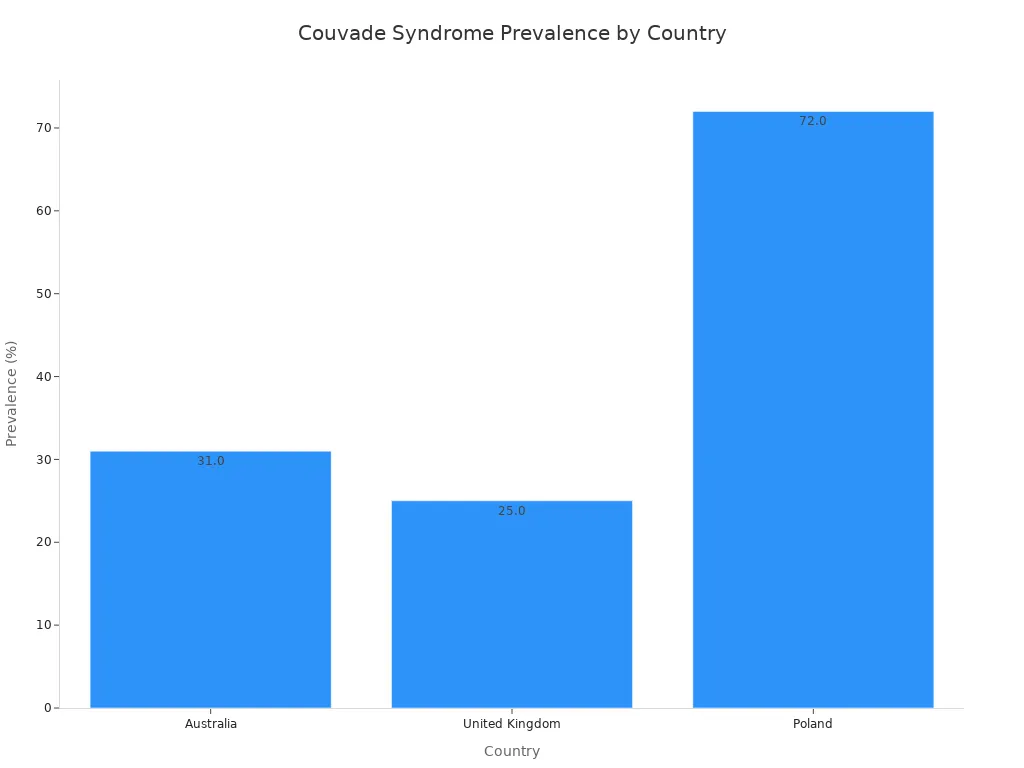
Rates also differ by country, as the table below shows.
Country
Couvade Syndrome Prevalence
Australia
31%
United Kingdom
25%
Poland
72%
The wide range comes from different study methods and definitions. Even so, the numbers make one point clear. Many partners of pregnant wives and other women get these symptoms, and doctors see the pattern often.
When Men Experience Pregnancy Symptoms
Couvade Syndrome in Expectant Fathers
Couvade syndrome usually means expectant fathers. A dad-to-be sees his partner's body change and hears the baby's heartbeat. He feels the birth getting closer. His own body may answer with nausea, weight gain, or mood swings. This pattern is not just for biological fathers. Any partner who is not pregnant can feel these changes, including adoptive parents and same-sex partners. The label simply names a common response to an approaching birth.
The word couvade comes from a French verb, couver, which means to hatch or brood. Anthropologist Edward Burnett Tylor made up the term in 1865. The modern meaning grew from an older French saying, faire la couvade, which meant "to sit doing nothing." Early observers tied the word to rituals that marked a man's entry into fatherhood. A community might ask a new father to rest, fast, or follow special rules after a birth. These customs treated the arrival of a child as a big life change for both parents.
Why the Term Matters
The couvade syndrome label helps families and doctors talk about a real pattern. It frames the symptoms as a psychosomatic equivalent of pregnancy, not a disorder. The mind and body work together, and the result is real physical change. A man with these symptoms is not making up his nausea or his backache. He is responding to a major life event with his whole body.
This framing matters for husbands of pregnant women and for men with pregnant wives who feel confused by their own bodies. A clear name reduces shame. It tells a partner that many others share the experience. It also gives clinicians a starting point for questions about sleep, diet, and stress. The term does not pathologize male experiences of pregnancy. Instead, it describes a normal, temporary response that usually fades after delivery. Couvade syndrome: when men experience pregnancy symptoms is a phrase that names the pattern plainly. Couvade syndrome: when men experience pregnancy symptoms also invites open conversation. Couvade syndrome, the couvade syndrome, and couvade all point to the same human response. Pregnant partners and fathers alike benefit when everyone understands it.
Why It Happens: Psychology
Empathy and Emotional Involvement
Empathy is at the heart of most psychological explanations. A partner shares the feelings of the pregnancy, and his body reacts to those feelings with physical changes. Researchers call this sharing compathy, which is the physical side of empathy. Distress always involves the body, so a man who feels his partner's strain may also feel her nausea.
A study of empathy parts shows which one matters most. The table below sums up the findings.
Empathy part or measure
Link to couvade syndrome
Statistic
Personal distress
The only part that relates positively to the syndrome
Spearman's rho = 0.229; p < 0.05 (one-sided)
Empathy overall model
A significant predictor that explains 7% of symptom variance
R = 0.273; R² = 0.074; adjusted R² = 0.049; F[3,109] = 2.917; p < 0.05
Personal distress as its own predictor
A separate predictor of the syndrome
Beta = 0.262; p < 0.01
Age and education
No significant role
Not significant
Personal distress means the habit of soaking up other people's bad feelings. A man with high personal distress feels the pregnancy deeply, and his body follows along. When he cannot handle that distress, he may slip into egocentric deviation. He turns self-centered instead of partner-centered, and the symptoms land on him. This pattern ties emotional involvement with pregnancy to real physical discomfort.
Anxiety About Parenthood
Worry clearly plays a part in starting symptoms. Researchers link nausea and vomiting partly to anxiety and restlessness, not just to estrogen shifts. Expectant fathers share the restlessness their partners feel, which makes anxiety a shared and empathetic factor.
The thought of fatherhood stirs mixed emotions and heavy rumination. These feelings disrupt sleep, and poor sleep feeds fatigue and nausea. A few threads of worry stand out:
Anxiety and restlessness drive nausea and vomiting in many cases.
Fathers-to-be pick up the same restlessness their partners have.
Coming fatherhood raises rumination and mixed emotions, which disturb sleep.
Getting ready for birth and learning supportive fatherhood skills lowers fear and anxiety.
That last point matters for coping. Anxiety can be changed. A man who learns about labor, goes to classes, and practices support skills often feels calmer, and his symptoms may ease.
Identification With the Partner
Identification goes past simple sympathy. Some experts trace the syndrome to empathy so strong that the father's body copies the pregnancy. Partners who join prenatal visits, feel kicks, and attend delivery tend to show stronger empathy. That closeness may lead them to take on their partner's pain and discomfort.
Symptoms of the syndrome are seen as showing an empathic identification with the pregnant partner and the unborn child. A psychoanalytic account adds a protective function: the syndrome lets the expectant father identify with his partner and strengthens his protective instincts toward her and the baby.
Psychology offers several frameworks for this process. Psychoanalytic theory points to envy of procreative ability and to mixed feelings about the unborn child as a rival. Psychosocial theory focuses on the small role men hold during gestation, especially first-time fathers. Paternal transitional theory calls the shift from dyad to triad one of the most stressful periods for an expectant man. Attachment theory ties symptoms to closeness with the fetus. A 1983 study of first-time expectant men found tiredness in 34%, sleeping difficulties in 33%, indigestion in 14%, stomach upsets in 12%, appetite changes in 8%, and constipation in 6%. The authors concluded that symptoms reflect attachment to and involvement in the pregnancy.
These theories share one theme. Men who feel deeply connected to pregnant wives and to the unborn baby often feel the pregnancy in their own bodies. The psychology of the couvade syndrome is therefore a story of closeness, worry, and identification, not weakness.
Hormonal Theories
Testosterone and Estrogen Shifts
Hormones give researchers a way to measure sympathetic pregnancy. Expectant fathers often have lower testosterone than men who are not fathers. This drop starts early in the pregnancy. Lower testosterone before birth also predicts more involvement with the mother and child after birth. One study of first-time fathers found no big drop from pregnancy to after birth. That result conflicts with some earlier work. A rebound after birth, with levels rising between 3 and 10 months, may explain the missing drop.
Couples matter here too. Stronger ties between partners before birth predicted bigger drops in fathers' testosterone after birth. This suggests that syncing with a pregnant partner may help a man adjust to fatherhood. Estradiol also rises in expectant fathers, along with prolactin and cortisol. Researchers describe these shifts as a trade-off between mating effort and parenting investment. This pattern also appears in pair-bonded male animals.
Prolactin and Cortisol
Prolactin has the clearest link to how bad symptoms get. Men with more couvade symptoms show higher prolactin levels and bigger testosterone drops than men with fewer symptoms. Researchers believe these hormone changes support paternal care. Dr. Alrahmani notes that fathers show a testosterone drop and a rise in prolactin and oxytocin during pregnancy. Researcher Brennan adds that the trigger seems tied to men with the most concern or responsiveness to the unborn baby. This may reflect empathy or anxiety.
Cortisol, the stress hormone, plays a more complex role. The table below sums up what studies report.
Cortisol finding in fathers
Associated effect
Higher prenatal cortisol
Predicted lower parenting quality 6 weeks after birth
Reactivity to infant crying
Levels rise in response to crying
Holding the newborn or playing with a toddler
Levels fall
High cortisol plus high testosterone
Negatively linked to caregiving quality in prenatal doll care
Chronic high cortisol
May work against sensitive parenting
Pregnancy brings rises in oxytocin, estradiol, testosterone, and cortisol, with oxytocin and cortisol peaking around childbirth before falling postpartum. Researchers ask whether similar changes prepare men for fatherhood.
Some scientists also suspect cortisol shifts drive weight gain in fathers-to-be, though few studies test this directly.
How Strong the Evidence Is
The hormonal picture is promising but incomplete. Many studies use small samples, and results sometimes disagree, as the first-time fathers study shows. Researchers cannot yet say which hormone causes which symptom. The correlations are real, yet causation remains open. A man with high prolactin and low testosterone may feel nausea and fatigue, but science has not proven the direction of that link. Readers should treat hormonal explanations as strong hypotheses rather than settled facts.
Social and Cultural Factors
Couvade in Cultural Context
Couvade rituals show up in many societies around the world. Anthropologists have written about customs where a father-to-be rests, fasts, or follows special rules during and after birth. These practices treat a child's arrival as a big life event for both parents. The modern symptoms echo those old customs in a bodily form. A community that once asked a new father to sit quietly now sees him feel queasy instead.
Culture shapes how openly a partner shows these symptoms. Some communities expect men to stay quiet about physical complaints. Others treat a father's involvement as a public role. A man in a supportive culture may report nausea and fatigue more freely. A man in a stoic culture may hide the same feelings. Reported rates therefore reflect culture as much as biology. In many cultures, women get most of the attention during pregnancy, and the father's role stays in the background. Workplace norms matter too. A father with no leave and little sympathy at work may push his symptoms down. A father with flexible hours and an understanding boss may speak up.
Relationship Dynamics
The couple's bond plays a central role. Several dynamics stand out:
Anxiety about the change ahead: fear about becoming a parent, finances, or the birth itself is common and can show up in the body.
Empathy and involvement: men more closely engaged with the pregnancy appear more likely to experience symptoms, which argues against couvade reflecting detachment.
Exclusion or helplessness: some accounts point to the strain of being deeply invested in something happening to someone else's body.
Guilt or envy: older literature proposed these drivers, though they remain speculative historical theories.
A clinical case report describes the syndrome as a somatic expression of anxiety. The patient's symptoms came from psychological issues and social stressors. His family dynamics showed severe enmeshment and dependency on her daughters. This case shows how intense family closeness can feed the symptoms. The mind carries the family's strain, and the body answers.
The dynamic can also strain the couple. One partner may feel that the other is taking over her experience. Naming the situation plainly usually defuses that tension. Addressing the anxiety underneath helps too. Stress-reduction practices, therapy when worry persists, and couples support all ease the load when the pregnancy strains the relationship. Open talk about roles and feelings helps both partners feel seen. A man who says "I am scared too" often finds his nausea eases. A woman who hears it feels less alone. The symptoms rarely need a cure. They need a conversation.
What Research Says
Key Findings
New studies show a steady pattern of who gets symptoms and why. The findings below sum up the main conclusions.
Expectant fathers get couvade symptoms tied to weight, like weight gain, appetite changes, and gas.
The only empathy part that relates positively to Couvade Syndrome is personal distress — the habit of taking on other people's bad feelings.
Traits like age and education are not linked to Couvade Syndrome.
How often men get couvade symptoms is linked to male empathy; men who are sensitive or easily upset may feel their partner's pregnancy in their bodies, which researchers call compathy.
A 2021 case report describes Couvade Syndrome as a somatic symptom disorder. The partner has body symptoms during pregnancy, most often in the first and third trimesters. The report notes proposed psychoanalytic theories and well-studied mood changes that match hormone shifts in response to expected parenthood. These shifts act as a body mechanism. The report concludes that expectant fathers should be checked for Couvade Syndrome throughout pregnancy to better support the family. This advice matters because it shifts the focus from ignoring symptoms to actively looking for them.
Open Questions
Researchers still face several gaps in understanding. The table below outlines the main open questions and what current evidence shows.
Open Question
Evidence from Source
Exact cause unknown
The exact cause of Couvade Syndrome is still unknown; top ideas involve hormonal, psychological, and social factors.
No definite treatment
Because the condition is mostly psychosomatic, no set or prescribed treatment plan exists.
Unexplained individual variation
There is no answer for why only some men get the syndrome.
Uncertain prevalence
Exact rates are hard to get because culture can block men from taking part in pregnancy.
Need for continued study
Causes and rates are still being studied, which shows the complex mix of psychological, hormonal, and social factors.
The couvade syndrome raises questions that touch on psychology, biology, and culture at once. The exact cause of couvade is still unknown. Top ideas involve hormonal, psychological, and social factors. Because the condition is mostly psychosomatic, no set or prescribed treatment plan exists. Researchers also cannot explain why only some men get the syndrome. Exact rates are hard to get because culture can block men from taking part in pregnancy. Causes and rates are still being studied, which shows the complex mix of psychological, hormonal, and social factors. The psychology of the condition remains a rich field for future study.
Coping and Next Steps
When to See a Doctor
Couvade syndrome is common and generally harmless. Most partners ride out the nausea, fatigue, and aches without any treatment. The symptoms usually fade on their own after delivery. A partner can treat mild complaints at home with rest, water, small meals, and gentle exercise. These simple steps often bring relief within days. A partner should not feel ashamed of these feelings. They are real, and they respond well to care.
Some situations call for a healthcare provider. A man should book a visit if his physical symptoms are severe, lasting, or troubling. Constant vomiting, major weight loss, or pain that will not settle deserves a check. So does low mood or anxiety that disrupts daily life. A doctor can rule out other causes and offer support. Naming the pattern helps. A partner can tell the clinician that he suspects couvade syndrome and describe when the symptoms started. He can also note how the symptoms track with his partner's pregnancy. That timeline gives the doctor useful clues.
Emotional strain deserves the same attention. A man who feels hopeless, panicky, or unable to sleep for weeks should reach out. Therapy and stress-reduction practices can ease the load. The goal is not to label the partner as sick. The goal is to help him stay well during a big life change.
Practical Preparation
Preparation gives a partner a sense of control. Many hospitals and birth centers offer hands-on classes, such as "Understanding Fatherhood for Dads and Partners." These sessions let men practice newborn care with infant mannequins. Key skills include supporting a newborn's head and neck, holding the baby close to the body, and learning to diaper. A partner can also pack a "dad bag" for the hospital and learn the A, B, Cs of Safe Sleep to lower SIDS risk. Practice builds confidence, and confidence lowers fear.
A calm plan covers the birth itself. Take a birth class together to align on expectations and support. Read birth stories, practice hands-on support positions, and know the birth plan inside and out. One dad advised: "Go to the clinic visits, be there for the home visit, ask questions, listen to the midwives, and just be present and there with your wife."
Home prep matters too. Childproof the house, prep and freeze meals, and set up diaper-changing stations. Choosing baby gear together opens a good talk about parenting intentions. Brands like Chiaus (chiausdiapers.com) offer maternal and baby care products that help partners stock up and feel ready. A partner can also plan finances, talk to HR about family leave, and stay fit with strength training. These steps ease worry, and lower stress may soften the physical symptoms.
Couvade syndrome is a real, short-term condition. A partner who is not pregnant gets pregnancy-like symptoms during a partner's pregnancy. Empathy, worry about parenthood, hormone changes, and social expectations all play a part. The psychology behind it shows how deeply a partner can connect to the experience.
While it can be uncomfortable, Couvade Syndrome is usually not harmful. It mostly affects the emotional and physical well-being of the expectant father. It poses no long-term health risks.
Readers who see couvade syndrome: when men experience pregnancy symptoms in themselves should feel reassured. The pattern is common and usually fades after delivery. A partner with severe or lasting symptoms should talk with a healthcare provider.
FAQ
Is Couvade syndrome dangerous?
No. Doctors see it as a mind-body response, not a disorder. Symptoms are real but temporary. Most cases go away on their own after the baby arrives. A partner should still see a provider if symptoms are severe or lasting.
When do symptoms usually start and stop?
Symptoms usually begin in the first trimester. They often ease during the second trimester. Many partners feel them return in the third trimester as birth gets close. After delivery, the symptoms usually clear up without treatment.
Can a partner get cravings and weight gain too?
Yes. Cravings, appetite changes, and weight gain show up in many reports. Some studies link couvade symptoms to weight-related complaints like appetite shifts and gas. These changes are real and usually mild.
Does Couvade syndrome affect only biological fathers?
No. Any nonpregnant partner can have it, including adoptive parents and same-sex partners. Most research focuses on expectant fathers, yet the pattern does not require a biological link to the baby.
What causes the symptoms?
Researchers point to three main drivers: empathy and identification with the pregnant partner, anxiety about parenthood, and hormonal shifts. Social and cultural expectations also play a part. The exact cause is still unknown.
Do hormone levels really change in expectant fathers?
Studies report lower testosterone and higher prolactin in many expectant fathers. Men with more symptoms tend to show bigger shifts. Cortisol findings are mixed. Researchers treat these links as strong hypotheses, not settled facts.
How common is it really?
Estimates vary widely. One review reports rates from 11% to 65% among husbands of pregnant women. Country studies differ too, with figures like 31% in Australia and 72% in Poland. Treat these as estimates, not exact counts.
Should a partner mention it to a doctor?
Yes, if symptoms are troubling. Constant vomiting, major weight loss, or low mood that disrupts daily life deserves a check. A provider can rule out other causes and offer support. Naming the pattern helps the conversation.