Toilet training a nonverbal child with autism can feel like a lot. Communication barriers do not make success impossible. Toileting resistance is more common among autistic children (49.1%) than among typically developing peers (8.0%).
Maybe your child has no words to signal "I need to go." Maybe the bathroom feels too loud or too bright. These hurdles are common in potty training a nonverbal autistic child with limited verbal abilities. They can be worked through.
Nonverbal kids with autism succeed with steady support. Here are 10 toilet training tips for kids with autism. Watch for non-verbal signals, build communication skills, and treat potty learning as a marathon. Progress may be slow. Every small win counts.
Key Takeaways
Set up a bathroom routine that stays the same, with planned times to sit, to help lower anxiety.
Use pictures and visual schedules to show each step of the potty routine.
Make the bathroom more comfortable for the senses by softening the lights, sounds, and textures.
Teach toileting in small steps, and reward each success right away.
Make a simple way for your child to ask for the bathroom, like picture cards or signs.
Tip 1: Build a Consistent Toilet Training Routine
Why predictability eases anxiety
A steady routine is the foundation of toilet training tips for kids with autism. Your child cannot tell you what comes next. A predictable schedule shows them instead. Research on autism backs this up. Scheduled sit routines help children with autism grow more familiar and comfortable with the toileting process. Same time, same place, same steps. That pattern lowers anxiety for a nonverbal child with autism.
Think of it as a script your child learns by doing. They start to expect the bathroom visit before it happens. Fear shrinks when nothing surprises them.
Setting a simple schedule
Start with bathroom visits every 30 to 60 minutes. You can also try a timer every 20 minutes with a 3-minute potty sit. Keep the sit short and calm. One successful program capped sitting at 3 minutes and removed diapers during school hours. Staff gave a reward right after urination in the toilet. They then stretched the time between visits as each child mastered the prior interval. All 5 cases improved, and paraprofessionals ran the program with minimal clinical oversight.
Track what works for your child. Some days will flow. Others will not. Stick with the plan anyway. Consistency is what makes potty training click, and it turns potty learning into a calm habit rather than a battle. The potty training process rewards patience, so keep each step small and repeatable.
Tip 2: Use Visual Supports for Nonverbal Kids with Autism
Picture schedules and step cards
Words disappear fast for a child who does not speak. Pictures stay put. That is why visual supports sit near the top of the list of toilet training tips for kids with autism. A visual schedule shows the whole routine as a row of simple images. Step cards break the job into single actions. Together, they give nonverbal kids with autism a map they can read without hearing a single instruction.
Build your toileting visual schedule around your child's actual routine. Use a poster board, a laminated sheet, or a tablet. Draw or photograph each stage in order:
Walk into the bathroom.
Pull down pants.
Sit on the toilet.
Wipe.
Flush.
Wash hands.
Keep the pictures clear and colorful. Add arrows or checkmarks between them. A small card set works well too. Your child can hand you the toilet card or point to it. That gives them a way to ask, with or without speech.
Placing visuals in the bathroom
Location matters as much as the pictures. Mount the step cards on the bathroom wall at your child's eye level, in order from left to right. Put a toilet card within easy reach. Your child can grab it, hand it over, or tap it whenever they need to go.
Then model the steps while you point to each card. Keep your spoken words short. Point to the pants card and say "pants down." Point to the toilet card and say "sit." This pairs the picture with the action. Over time, the card alone carries the message.
These visual prompts also lower anxiety during potty training. Your child sees what comes next, so nothing feels like a surprise. Pair the cards with a timer and a steady routine. The bathroom stops being a mystery and starts being a place your child can predict. That predictability is a quiet powerhouse in autism toilet training, and it costs you nothing but a printer and some tape.
Tip 3: Create a Sensory-Friendly Bathroom
Adjusting lights, sounds, and textures
Sensory differences shape how your child experiences the bathroom. A flushing toilet can sound like a roar. Bright overhead lights can sting. A cold seat can feel shocking. These reactions are real, and they are common in potty training your non-verbal child.
Small changes to the room can make a big difference. Try these adjustments:
Swap harsh cool-white bulbs for warm-white LEDs in the 2700K–3000K range, and add a dimmer switch.
Install a soft-close toilet seat, run a quiet fan, or offer noise-cancelling headphones during flushing.
Choose soft, unscented toilet paper and gentle fragrance-free soap.
Add a padded seat insert, warm towels, and a rug so bare feet stay warm.
Then let your child explore the space with no pressure. Start with short visits and no toileting expectation. Let them sit on the closed lid with clothes on first. Move to sitting on the seat with pants down only when they seem ready. This gradual exposure builds comfort step by step.
Comfort items that reduce fear
A familiar object can turn a scary room into a safe one. Let your child bring a favorite toy or comfort object along. A soft blanket, a small figurine, or a scented wipe can all help.
"Comfort Items: Allow children to bring a favorite toy or comfort object to help mitigate anxiety."
Pair that comfort item with the visual supports you already use. Your child holds the toy while they check the visual schedule on the wall. The toy becomes part of the routine, and the routine becomes less frightening. Keep sessions short and calm. Praise every small step, even a quick touch of the bathroom door. These toilet training tips for kids with autism work best when the bathroom feels safe, not stressful.
Tip 4: Teach with Modeling and Social Stories
Simple demonstration techniques
Your child learns by watching. Show them the steps yourself, one at a time. Sit on the toilet with clothes on. Pull your pants down slowly. Point to each action as you do it. Keep your face calm and your movements slow. This is modeling, and it works well in autism potty training.
Video modeling takes the same idea and puts it on a screen. Your child watches a short clip of each toileting step. The clip shows the sequence from start to finish. Many kids tune in to video more easily than to a live adult. Social stories add words to the picture. These are short, simple tales about the bathroom. A therapist or teacher can help you write one. The story describes the routine in a positive way. It prepares your child for what comes next.
Method
How you use it
What it does
Video modeling
Your child watches a visual demonstration of each toileting step
Gives visual cues to teach the sequence of steps
Social stories
A short story describes toilet routines and expected behaviors in a positive, straightforward way
Builds familiarity, prepares the child, and reduces anxiety and resistance
Visual supports plus steady rewards can move the needle. One school-based program using these methods reached over 80% accuracy in in-toilet urination within about two months.
Using videos and picture books
Picture books and cartoons feel like an easy win. They are not always. Many children's potty books lean on the potty chair as the teaching tool. Animated videos often skip the actual elimination process. Characters do not explain what to do or show the steps in detail.
That does not mean you skip them. It means you pair them with real teaching. Try picture symbols on a Velcro strip, a simple chart, and a social story with photos. Some children still need more. Sensory issues, stomach troubles, anxiety, and resistance to change can all slow progress. Keep your toilet training strategies flexible. Watch what your child responds to, then lean into it. These toilet training tips for kids with autism work best when you match the method to your child, not the other way around.
Tip 5: Break Toilet Training into Small Steps
Task analysis made simple
The whole bathroom routine can feel huge to a child who cannot talk it through. Task analysis fixes that. You split toileting into small, teachable steps. Then you teach one step at a time.
Here is a simple sequence you can follow:
Walk into the bathroom calmly.
Pull pants down.
Sit on the toilet.
Wait calmly.
Pull pants up.
Wash hands.
Start with comfort. Help your child enter the bathroom without stress. Let them sit on the toilet with clothes on. Reinforce that small step. Then move to the next one. Teach each skill on its own before you link them together. This keeps the pressure low and builds steady success. Once your child masters a step, connect it to the one before. The full routine grows in a manageable way.
Rewarding each small success
Praise and preferred toys work well as rewards. Keep them close and hand them out right away. Timing matters more than size. A quick "Great job sitting on the potty!" lands better than a big prize later.
Pick rewards your child truly loves. Verbal praise, stickers, small toys, and favorite activities all work. Choose items that motivate without causing frustration or distraction. Save a special treat just for potty training so it stays powerful. An ABA-based approach leans on this kind of positive reinforcement. Therapists and parents reward each completed step with praise or a preferred item.
These toilet training tips for kids with autism work because they celebrate small wins. Every sticker and every cheer tells your nonverbal child they did something right. That message builds confidence, and confidence carries the whole autism potty training journey forward.
Tip 6: Choose Easy-Access Clothing and Underwear
Moving from diapers to underwear
Clothing can either help or get in the way of potty training your non-verbal child. Loose pants with elastic waists come down fast. Buttons, belts, and tight jeans slow everything down. Pick outfits your child can handle alone, and practice pulling them up and down before you start.
Underwear itself may do more than you think. In one review, wearing underwear was the most important part of toilet training packages for young children. For some kids, that one change was enough to improve in-toilet voids. One participant, James, voided in the toilet on 50% of trips right after switching to underwear. He reached 100% by the sixth session. Another child mastered the routine once the diaper came off. Not every child responds this way, but the pattern is worth testing.
Finding
What it means for you
Underwear was the key component for many children
Try underwear early, before adding complex steps
Some children improved with underwear alone
A simple switch may be enough for your child
Results varied across children
Watch your child's response and adjust
During the transition, easy-access options help. Pull-up pants slide on and off quickly, which keeps bathroom visits short and calm. Use them for naps and bedtime, then switch back to underwear right after waking.
Why wetness awareness motivates
Many kids with autism take in sensory input in different ways. They may not notice the urge to go, or they may not feel the difference between wet and dry. Disposable diapers pull moisture away from the skin, so your child may never notice that they are wet. Underwear changes that. The damp feeling gives instant feedback, and that feedback teaches the wet-dry difference.
Some children still don't seem to notice wetness. One parent went straight to underwear and gave more fluids to raise urination frequency. Her sons did not seem bothered by being wet. Steady timing, catching successes, and quick rewards still got them fully trained within a few weeks. So treat wetness awareness as a helpful tool, not a strict requirement. Watch for longer dry stretches as a sign of readiness, and keep sessions short and positive.
Tip 7: Read Your Child's Body Signals
Common signs of needing to go
Your child may never say "I need to go." Their body still sends messages. You just have to learn the language. Watch for squirming, holding the crotch area, or pressing their legs together. Some kids hide behind a couch or go quiet in a corner. Others look straight at you or drift toward the bathroom door. Treat every one of these as a real signal, and respond fast and warmly.
Here is the hard part. Many nonverbal children show no crossed legs and no potty dance before an accident. Do not rely on classic signs alone. Build a nonverbal communication system instead. Tape a small toilet picture to your child's clothing. Teach a simple sign for "bathroom." Program one button on an AAC device. These tools give your child a way to tell you before it happens.
Tracking patterns to predict timing
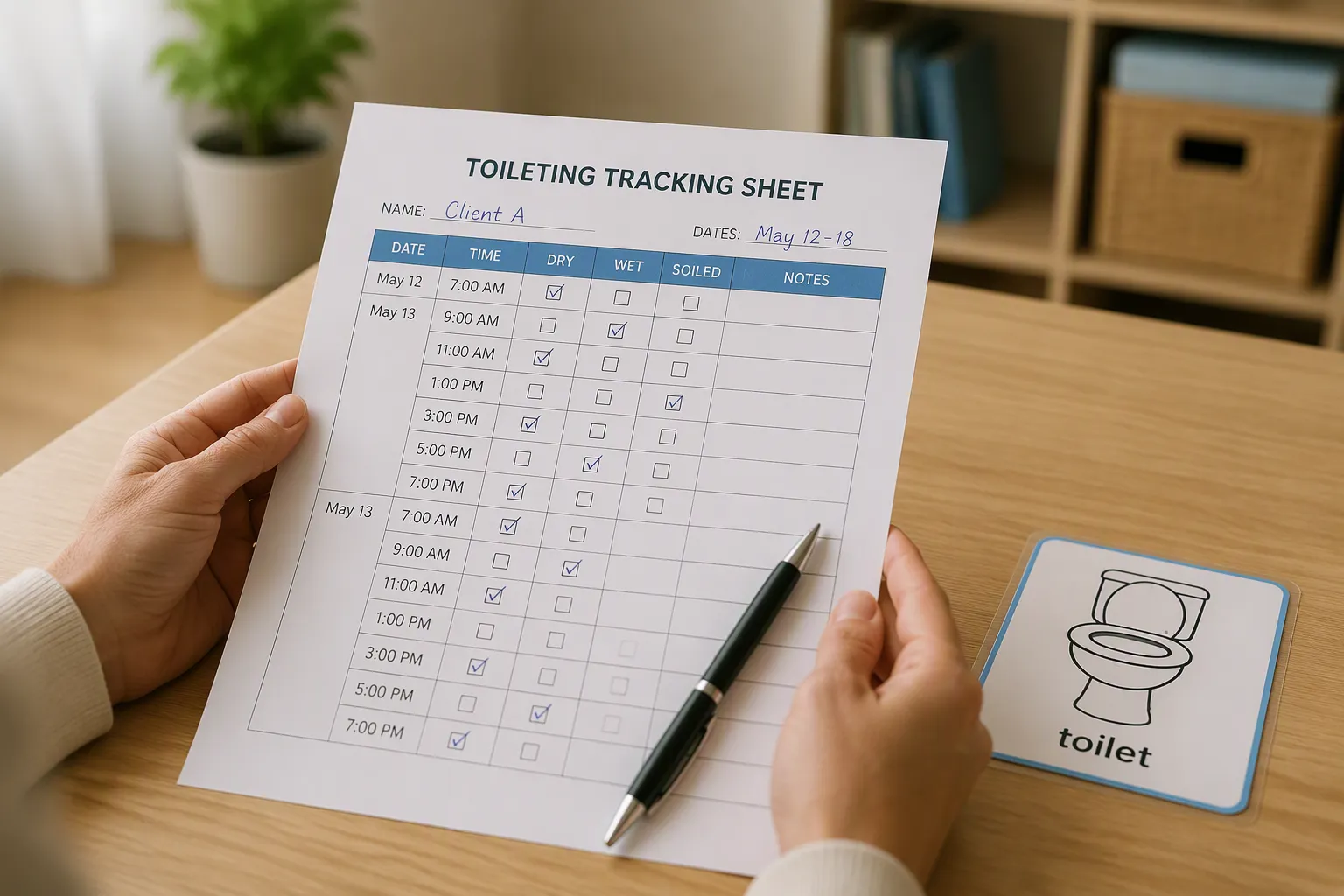
A simple data sheet can do the work your child's body signals cannot. Record a 3–5 day baseline before you change anything. That shows your child's natural pattern and gives you a starting point. Then log the date, time, and dry, wet, or soiled status at consistent check times. More entries make the pattern easier to see.
Tracking step
How it helps predict toileting times
Record a 3–5 day baseline first
Reveals the natural pattern and sets a reference for later progress
Log time and dry/wet/soiled status at set checks
More entries make a recurring pattern visible
Compare consecutive checks (dry at 9:00, wet by 9:30)
Narrows the likely window, so you can schedule a sit just before it
Note drinks, meals, illness, and routine changes
Explains variations and sharpens predictions
Use patterns to infer signals your child may not feel
Substitutes for interoception differences, such as not sensing a full bladder
Review data to adjust the interval between visits
Shows when the schedule no longer fits your child
Many kids with autism process internal body cues differently. They may not feel a full bladder at all. Your records stand in for that missing signal. Review them weekly, and let the data guide your potty training schedule. This steady tracking turns guesswork into a plan, and it keeps toilet training moving forward even on tough days.
Tip 8: Build Communication with AAC and PECS
What AAC and PECS are
Your child needs one reliable way to tell you the bathroom is calling. Spoken words are not required. Before you start toilet training, confirm your child has a dependable way to express needs. That can be a single word, a sign, a gesture, or a picture.
Augmentative and alternative communication, or AAC, covers any tool that replaces or supports speech. It includes speech-generating apps, tablets, and simple picture boards. PECS, the Picture Exchange Communication System, is a structured approach. Your child hands you a picture card to make a request. Both give a nonverbal child with autism a voice in the bathroom.
Teaching simple 'potty' signals
Pick one signal and stick with it. That single, consistent cue is the core principle. Reinforce it every time, and your child learns that the signal works.
Use PECS so your child can request the bathroom.
Set up AAC devices or apps with potty-related buttons.
Allow sign language or gestures to signal the need.
For PECS users, place a bathroom card at eye level near the bathroom door. Model handing the card to you before each routine visit. The card becomes the request, and the routine becomes the response. Reinforce the exchange right away. Start the walk to the bathroom the moment the card is traded.
For AAC users, pair every spoken direction with a tap on the bathroom icon. Ask your speech-language pathologist to add bathroom symbols to the page set. Some systems need that addition. Make sure your child can reach five core symbols before training: bathroom, more, hurt, yes, and no.
No formal system yet? Try a simple two-card exchange with a bathroom card and an all-done card. Then consult a speech-language pathologist. These steps build communication skills that carry far beyond the bathroom.
Tip 9: Respond Calmly to Accidents and Resistance
Avoiding power struggles
Accidents will happen. They are a normal part of learning, not a sign of failure. Your reaction teaches your child more than any lesson you plan. Stay calm and neutral. Skip punishment and long lectures. Shame raises anxiety and can delay progress in autism potty training.
Try this simple response instead:
State the fact in plain words: "Pee goes in the toilet."
Gently guide your child to help clean up.
Return to the toileting schedule without drama.
Keep your words and steps consistent. Share the plan with school staff and other caregivers. Dress your child in easy clothes. Avoid comparing them to siblings or peers. Never force a long sit that feels like a trap. A calm, supportive presence helps your child feel safe enough to try again.
Sometimes resistance wins the day. That is okay. CHOP notes that when toilet training turns into a power struggle, you can pause and restart once everyone is ready.
A break is not a setback. It is a reset.
Offering choice and control
Resistance often grows from anxiety, sensory overload, or trouble with change. Choices shrink that pressure. Let your child pick their own potty or underwear. Even a small choice, like fun underwear, can raise their willingness to join in.
Offer options during each visit. Ask which book to read or which toy to hold. Keep the choices limited to two so the decision stays easy. Then follow your child's lead. A nonverbal child can point, tap, or reach for what they want.
Watch for the root of the resistance too. Visual aids and simple signs can ease the transition. Acknowledge feelings with short phrases like "I know, sitting is hard." These small moves build trust and reduce battles. Every calm response and every choice you offer moves autism toilet training forward.
Tip 10: Know When to Seek Professional Help
Signs it's time for extra support
You have tried the routine, the visuals, and the calm responses. Sometimes that is still not enough, and that is not your fault. Watch for a few clear signals. Your child shows no progress after weeks of steady effort. Bathroom visits cause extreme distress, with crying, meltdowns, or panic. You notice medical concerns, like pain, unusual bowel habits, or changes in urination.
If you're having a hard time with toilet training or facing big challenges, don't wait to get help from professionals such as pediatricians, behavior therapists, or occupational therapists. They can give you guidance, strategies, and support that fits your child to help them succeed.
A referral to an autism specialist makes sense when standard advice has run out and your child still is not using the toilet on a regular basis. Your pediatrician should first check for and treat medical causes, such as urinary tract infections or neurological or endocrine disorders. Coaching for parents can also help many families get past a stuck point.
Who to contact and what to ask
Start with a pediatric health review. That visit rules out or addresses medical causes before anyone teaches new skills. Then set goals with your child and family, and bring in a qualified professional who works within their scope.
Professional
Role in toileting support
Pediatrician
Checks for health-related causes and directs medical care; the starting point before behavioral work.
Occupational therapist
Helps with comfortable sitting, clothing management, wiping, handwashing, scheduling, and public-restroom use.
ABA therapist (BCBA)
Looks at learning and environmental factors, designs and teaches skills, trains caregivers, and updates the plan.
A pediatric occupational therapist can help with the basic skills when toileting is stuck — managing clothing, sitting comfortably, wiping, and following the steps of a bathroom routine.
Ask each one a direct question: "What is blocking my nonverbal child's progress, and what should we try next?" Bring your tracking notes to the visit. Those records give the professional a head start on toilet training.
Your toilet training toolkit is full now. A steady routine, visual supports, and a sensory-friendly bathroom set the stage. Modeling, small steps, and easy clothing keep momentum going. AAC and PECS build communication skills, and professional support stands ready when you need it.
Progress rarely follows a straight line. Some weeks bring wins. Others bring accidents. Patience with your child, and with yourself, matters most.
Do not try all ten toilet training tips at once. Pick one or two this week. Start with a timer and a picture card. Then build from there.
Every small step counts in potty learning. Celebrate each one. Your nonverbal child is learning, and so are you.
FAQ
How do I know my child is ready to start potty training?
Look for a few signs. Your child stays dry for longer stretches, shows interest in the bathroom, or seems bothered by a wet diaper. They may also follow simple routines and sit still for a short time. No single sign is required. You can start building bathroom visits even before every sign appears.
How long does potty training usually take?
There is no fixed timeline. Some children learn in a few weeks. Others need many months of steady practice. Your child's pace depends on sensory needs, communication skills, and routine consistency. Track small wins instead of watching the calendar. Slow progress still counts as progress.
Should I train for nighttime and daytime at the same time?
Start with daytime first. Daytime dryness usually comes before nighttime control. Keep using absorbent protection at night while you focus on daytime visits. Once your child stays dry through most days, watch for dry mornings. That pattern often signals nighttime readiness.
How do I keep training consistent with school and other caregivers?
Share your plan in writing. Give teachers and sitters the same schedule, visual cards, and reward ideas you use at home. Ask them to log bathroom visits. Compare notes weekly. A nonverbal child benefits most when every adult follows the same steps and signals.
What should I do if my child was trained and then starts having accidents again?
Expect some backsliding. Illness, routine changes, and stress can all trigger it. Return to the basics: steady visits, visual supports, and calm responses. Check for medical causes like constipation or infection. Stay patient. Most children regain skills once the routine settles again.